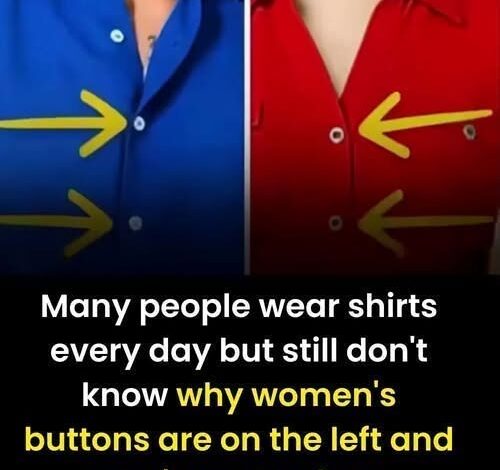
Most people button their shirts every day without giving a second thought to which side the buttons are on. Yet hidden within this ordinary routine is a small detail that has survived for centuries: women’s shirts typically button from the left, while men’s shirts button from the right.
At first glance, it seems like an insignificant design choice. But behind this subtle difference lies a fascinating history shaped by social class, gender roles, practicality, and tradition.
To understand where it began, we have to look back to a time when clothing served a very different purpose. For wealthy women in the 18th and 19th centuries, getting dressed was often far from simple. Elaborate gowns, corsets, petticoats, and fitted bodices could require considerable time and effort to put on. For many upper-class women, dressing was not a solitary task but one performed with the assistance of servants or maids.
Because most people were right-handed, placing buttons on the left side of a woman’s garment made it easier for a maid standing opposite her to fasten the clothing. The design was created not for the convenience of the wearer, but for the person helping her dress.
What appears today as a minor fashion detail was once connected to a social structure built around wealth and status. The ability to rely on assistance for everyday tasks was itself a symbol of privilege. Clothing reflected that reality, quietly signaling a lifestyle far removed from manual labor and self-sufficiency.
As decades passed, fashions changed and women’s lives became increasingly independent. Clothing grew more practical, and most women dressed themselves. Yet the button placement remained.
What started as a practical solution gradually became a tradition.
Over time, the left-side button arrangement became associated with women’s fashion simply because it had always been done that way. The original reason faded from memory, but the convention survived.
Men’s clothing followed a different path.
Historically, men’s garments were heavily influenced by military needs, horseback riding, and public life. Since most men were right-handed and often carried swords or weapons on the left side of their bodies, fastening garments from the right made it easier to reach across the body and draw a weapon quickly when necessary.
Practicality, mobility, and readiness shaped the design.
Military uniforms helped reinforce these standards, and as military styles influenced civilian clothing, right-side buttons became the norm for men’s shirts, jackets, and coats.
In many ways, the contrast reflected broader social expectations of the time. Women’s clothing often emphasized appearance, status, and domestic roles, while men’s clothing prioritized movement, utility, and authority.
Today, those original circumstances have largely disappeared.
Few people rely on servants to get dressed.
Few carry swords.
Modern clothing is mass-produced and designed for convenience.
Yet the distinction remains.
Every morning, millions of people continue fastening buttons according to a convention established generations ago, often without realizing they are participating in a tradition rooted in history.
That is what makes this tiny design feature so intriguing.
Clothing often preserves pieces of the past long after the world that created them has vanished. A simple row of buttons can carry echoes of class systems, military customs, gender expectations, and social hierarchies that shaped everyday life centuries ago.
It serves as a reminder that design is rarely accidental.
Many of the objects we use daily—from clothing to tools to architecture—reflect choices influenced by the values, needs, and power structures of the societies that created them.
The difference between men’s and women’s shirt buttons may seem trivial, but it offers a glimpse into how traditions endure. What began as a practical solution evolved into an unquestioned convention, passed down through generations until it became invisible.
And perhaps that is the most interesting lesson of all.
Sometimes the smallest details reveal the largest stories.
A row of buttons.
A forgotten custom.
A quiet reminder that history often survives in the places we least expect.