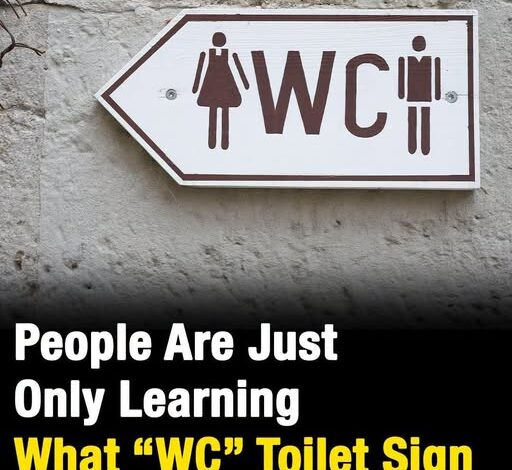
Most people have seen the letters “WC” on a restroom sign at some point and wondered what they actually mean. Whether in an airport, hotel, restaurant, shopping center, or train station, those two simple letters often leave travelers briefly puzzled. Why not just write “bathroom” or “restroom”? And what exactly is a water closet?
The answer is surprisingly simple. WC stands for “water closet,” an older term used to describe a small room containing a toilet. While the phrase may sound unusual today, it has roots in the early days of indoor plumbing and remains widely recognized around the world. In many public places, especially those serving international visitors, WC functions as a universal label that people from different countries can understand regardless of the language they speak.
Once you start thinking about it, though, many of the words we use for this room are a little strange. A bathroom doesn’t always contain a bathtub. A restroom is rarely a place where anyone goes to rest. A washroom isn’t usually where people do their washing beyond cleaning their hands. And a water closet sounds more like a storage space than a toilet.
These names developed over centuries, shaped by culture, etiquette, and changing technology. Each reflects a different way societies have tried to talk politely about one of life’s most basic necessities.
The topic gained widespread attention online when a lighthearted video highlighted the differences between American and Canadian terminology. In the clip, a man jokingly questioned why Canadians call it a “washroom,” pointing out that the only thing he typically washes there is his hands. His partner quickly responded with a question of her own: “Do you actually rest in a restroom?” The exchange amused millions because it exposed how little sense many of these terms make when taken literally.
The history of “water closet” dates back to a time when indoor toilets were becoming more common. In earlier homes, bathing and toilet facilities were often located in separate rooms. The bathroom was where people bathed, while the water closet housed the flushing toilet. As indoor plumbing evolved and homes became more efficient, these spaces were gradually combined into a single room. Even though the layout changed, many of the old names survived.
Before modern plumbing became widespread, most families relied on outdoor facilities such as outhouses. Indoor toilets were considered a luxury, particularly during the nineteenth century. As technology improved and plumbing systems expanded, having a water closet inside the home represented a major advancement in comfort, convenience, and hygiene.
Today, the term WC survives largely because it is short, practical, and internationally understood. Travelers may use different words at home—bathroom, restroom, washroom, toilet, lavatory, or loo—but many still recognize WC immediately when searching for a restroom in an unfamiliar place.
Different countries continue to favor different terms. Americans commonly say “bathroom” or “restroom.” Canadians often prefer “washroom.” In the United Kingdom, “loo” and “toilet” are frequently used. Elsewhere, “lavatory” or “WC” may be more common. None of these terms are universally perfect; they simply reflect local habits and traditions.
What makes the discussion so interesting is that such an ordinary room can reveal so much about language and culture. The words people choose often have less to do with logic and more to do with history, politeness, and everyday custom.
So the next time you spot a sign marked WC, you’ll know exactly what it means. It’s simply another name for a restroom—a small reminder of how language evolves and how old terms can survive long after their original context has changed.
Whether you call it a bathroom, restroom, washroom, toilet, loo, lavatory, or water closet, the destination remains the same. Only the name changes depending on where you happen to be.