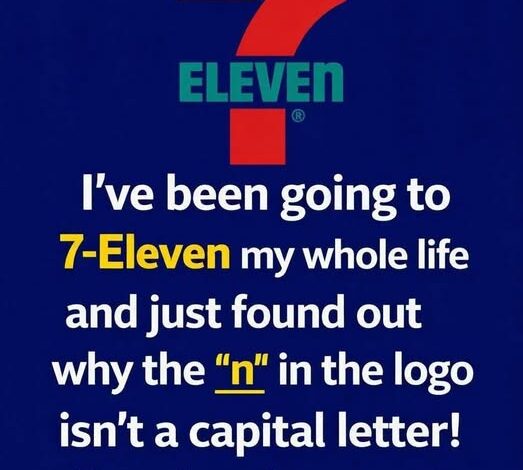
The 7-Eleven logo is one of the most recognizable retail symbols in the world. Its signature red, orange, and green colors can be found on storefronts across countless cities and countries, making it instantly familiar to millions of people. Yet hidden within this famous design is a small detail that many customers never notice: the final letter in “Eleven” is lowercase, while the rest of the word appears in uppercase lettering.
At first glance, it seems like an unusual inconsistency. Some people assume it was a printing error or an overlooked design choice. In reality, the lowercase “n” was a deliberate decision that has remained part of the company’s identity for decades.
To understand why, it helps to look at the history of the brand itself.
The company’s story began in 1927 in Dallas, Texas, where it operated under the name Tote’m Stores. The idea was simple but innovative for its time: provide customers with everyday necessities such as milk, bread, and eggs in one convenient location. Instead of visiting several specialty shops, shoppers could find what they needed in a single stop.
In 1946, the company adopted a new name that reflected one of its biggest selling points. At a time when most stores closed early, these locations remained open from 7 a.m. until 11 p.m. The extended hours were unusual enough to become the foundation of the brand’s new identity, giving birth to the name 7-Eleven.
As the company expanded, it needed a logo that would stand out. Designers emphasized the large number “7” and paired it with the word “Eleven,” using bright colors that could be easily recognized from a distance. The result was a bold, memorable design that quickly became associated with convenience and accessibility.
Over the years, the business continued to evolve. During the 1960s, some locations began experimenting with staying open around the clock to meet customer demand. The idea proved successful, eventually helping establish 7-Eleven as one of the most recognized 24-hour convenience store chains in the world. Even though operating hours changed, the name remained the same because it had already become a powerful and trusted brand.
One of the most interesting aspects of the logo emerged during its development. Early versions reportedly used all capital letters. While the design was strong and easy to read, some felt it appeared too rigid and aggressive. According to company history, the wife of then-president Joe C. Thompson Jr. suggested changing the final letter in “Eleven” to lowercase. Her reasoning was simple: the adjustment would soften the logo and make it appear more friendly and welcoming.
The company embraced the suggestion, and the lowercase “n” became a permanent feature of the design.
There was no hidden message behind the change. It was not intended to symbolize anything secret or mysterious. Instead, it reflected a basic principle of branding: small visual details can influence how people perceive a company. The subtle typography change helped balance the logo’s bold appearance while maintaining its strong visibility.
Today, most customers never consciously notice the lowercase letter. Yet it remains one of the logo’s most distinctive characteristics. It is a reminder that some of the most effective branding decisions are often the simplest ones.
The 7-Eleven logo has undergone minor updates throughout the years, but its core identity has remained remarkably consistent. The large “7,” the vibrant color palette, and the distinctive wordmark continue to connect generations of customers with a brand built around convenience and familiarity.
What appears to be a tiny design quirk is actually a piece of the company’s history. The lowercase “n” reflects the thoughtful decisions that helped transform a small Texas grocery concept into one of the most recognizable retail brands in the world.
Sometimes, the smallest details are the ones that last the longest.