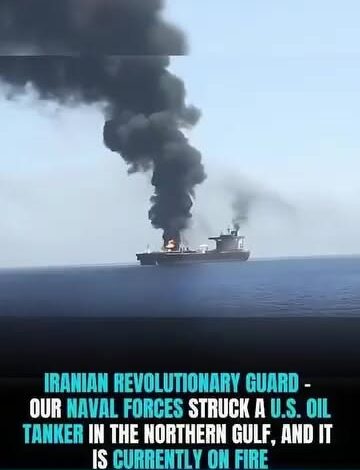
The announcement spread rapidly across international headlines.
In a region already strained by rising tensions, Iranian officials claimed that naval units of the Islamic Revolutionary Guard Corps had targeted a U.S.-linked oil tanker in the northern Persian Gulf, leaving the vessel reportedly engulfed in flames. If verified, the incident would mark one of the most significant maritime confrontations in the region in recent years.
Yet amid the immediate reaction, one critical question remained unanswered:
Did the attack actually occur?
At the time of the announcement, no independent evidence had confirmed Iran’s account. There were no verified photographs, no public confirmation from U.S. defense officials, no widely reported distress calls, and no supporting statements from major maritime monitoring organizations.
Despite the lack of verification, the claim itself was enough to attract global attention.
Diplomats took notice.
Energy markets reacted cautiously.
Military analysts began evaluating potential consequences.
Shipping companies monitored developments closely.
Because in the Persian Gulf, even unconfirmed reports can carry enormous weight.
According to Iranian officials, the reported operation was conducted as part of what they described as a broader phase of military activity connected to escalating regional tensions. Their statements suggested that the alleged strike was not an isolated event but part of a larger strategic posture.
The message became even more significant when Iranian authorities paired the announcement with warnings regarding the Strait of Hormuz.
Officials indicated that Iran intended to exercise greater authority over one of the world’s most important maritime corridors, raising concerns far beyond the Middle East.
The Strait of Hormuz serves as a vital gateway connecting the Persian Gulf to international markets. Every day, massive volumes of crude oil, liquefied natural gas, and commercial cargo pass through its narrow waters. Any disruption in the region has the potential to affect economies across the globe.
For decades, the strait has remained one of the world’s most sensitive geopolitical chokepoints.
Now it was once again under intense scrutiny.
Iranian officials warned that vessels associated with the United States, Israel, European countries, and allied nations could encounter difficulties if regional tensions continue to escalate.
The implication was clear.
Whether or not the reported tanker incident unfolded exactly as described, Tehran wanted to demonstrate that maritime traffic could become part of the broader confrontation taking shape across the region.
That possibility immediately elevated international concern.
Shipping operators reviewed potential risks.
Energy traders considered possible supply disruptions.
Governments examined contingency plans.
Military planners assessed how any threat to freedom of navigation might affect regional security.
History has shown that incidents in Gulf waters can escalate quickly.
The timing of the announcement only intensified those concerns.
The Middle East is already experiencing one of its most uncertain periods in recent memory. Military exchanges, retaliatory strikes, increasingly aggressive rhetoric, and ongoing tensions involving Iran, Israel, and the United States have fueled fears of a wider regional conflict.
Each new development has added pressure.
Each response has carried the potential for further escalation.
The prospect of an incident involving commercial shipping introduces yet another layer of uncertainty.
Still, important questions remain unanswered.
No independently verified information has established the vessel’s precise location.
Its ownership has not been publicly confirmed.
Its condition remains unclear.
The status of its crew is unknown.
There have been no verified reports of casualties or injuries.
Even the extent of any alleged damage remains uncertain.
For maritime experts, these missing details are significant.
Modern shipping operations are monitored through satellite imagery, vessel-tracking systems, commercial databases, and rapid communication networks. Major maritime incidents often generate multiple forms of confirmation within a relatively short period.
The absence of such evidence does not automatically invalidate Iran’s claim.
However, it does mean the situation should be approached carefully.
Until independent confirmation emerges, the reported attack remains an allegation rather than an established fact.
Yet allegations themselves can have consequences.
Markets rarely wait for complete certainty.
Governments do not always have that luxury either.
Even unverified reports involving the Strait of Hormuz can influence oil prices, insurance costs, military readiness, diplomatic planning, and commercial shipping decisions.
That reality helps explain why international observers have responded so attentively despite the lack of confirmed evidence.
The economic implications alone are considerable.
A confirmed attack on a commercial tanker could increase shipping costs throughout the Gulf region. Insurance companies may reevaluate risk assessments for vessels operating nearby. Energy markets could react to concerns about supply disruptions. Military forces might increase patrols to protect critical shipping routes.
The effects would extend far beyond the Middle East.
What happens in the Strait of Hormuz often affects the wider world.
Beyond economics lies an even larger issue.
Control.
Iran’s statements appear designed not only to describe an action but also to communicate capability.
By linking the reported incident to broader discussions of wartime authority and maritime oversight, Tehran seems intent on signaling that it possesses both the willingness and the capacity to influence activity in one of the world’s most strategically important waterways.
Whether that message is primarily military, political, strategic, or symbolic remains open to interpretation.
What is certain is that it was intended to be noticed.
And it was.
Around the world, diplomats, military officials, intelligence analysts, and energy executives are now watching closely for evidence that may either support or challenge Iran’s version of events.
Satellite imagery may provide answers.
Shipping records may reveal relevant movements.
Government statements could offer clarification.
Maritime advisories, crew communications, or emergency alerts may eventually help establish what occurred.
Until then, uncertainty remains the defining factor.
The coming days may determine whether this becomes another episode in a continuing regional standoff or a significant turning point with broader consequences.
Much depends on facts that have yet to emerge.
Was a tanker actually struck?
Was significant damage caused?
Were crew members endangered?
Was the vessel connected to American interests?
And perhaps most importantly, what happens next?
Because during periods of heightened tension, the response to an incident can become more consequential than the incident itself.
A confirmed attack could provoke diplomatic disputes, military reactions, and further escalation.
A disputed claim could intensify competing narratives and information campaigns.
A misunderstanding could evolve into a larger crisis.
And in an environment already defined by suspicion and hostility, crises can expand rapidly.
For now, the international community finds itself in a familiar position—waiting for evidence while preparing for potential consequences.
The reported fire may or may not have occurred.
The tanker may or may not have been struck.
But the concern spreading through governments, financial markets, and security institutions is undeniably real.
Until more information becomes available, one reality remains clear:
Any verified attack on commercial shipping near the Strait of Hormuz would represent a serious escalation with implications reaching far beyond the waters where it allegedly took place.
The claim has been made.
Questions remain.
And the evidence that emerges next may determine whether this becomes another chapter in an ongoing standoff—or the beginning of a much larger crisis.