The Academy Awards are often remembered for glamorous fashion, carefully rehearsed speeches, and unforgettable moments of Hollywood spectacle.
But on April 9, 1979, something happened that transcended the usual pageantry.
For a few extraordinary minutes, the ceremony became something far more human.
It became a farewell.
And at the center of that moment stood a man who had spent decades embodying courage on screen while quietly fighting for his life off it.
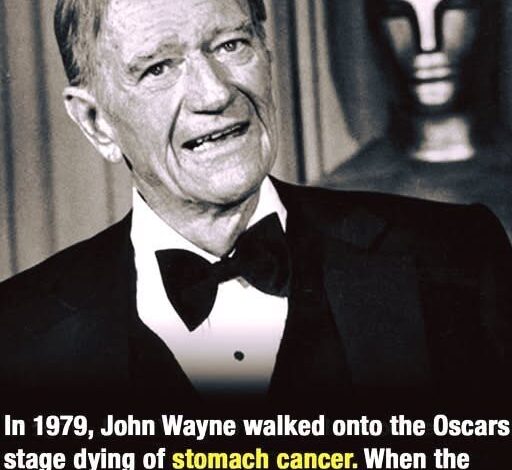
John Wayne was dying.
Yet when the stage doors opened that night, he stepped into the spotlight one final time.
What followed would become one of the most emotional moments in Academy Awards history.
To understand why that appearance mattered so much, it helps to understand what Wayne had endured in the months leading up to it.
By 1979, the legendary actor was seventy-two years old.
He had appeared in nearly two hundred films.
He had survived changing eras in Hollywood, outlasting countless contemporaries and becoming one of the most recognizable figures in American cinema.
But age was no longer his greatest challenge.
His health was.
Just months before the ceremony, Wayne underwent what was expected to be routine gallbladder surgery.
Instead, doctors discovered stomach cancer.
The operation became a grueling battle lasting nearly ten hours.
Surgeons were forced to remove his entire stomach in an effort to save his life.
It was not his first confrontation with serious illness.
Years earlier, he had overcome lung cancer, losing a lung and several ribs in the process.
He had endured open-heart surgery.
He had spent years relying on oxygen behind the scenes while continuing to project the image of an unstoppable American icon in front of audiences.
By early 1979, many believed the Duke was nearing the end.
The invitation to appear at the Academy Awards came from his longtime friend, Bob Hope.
For Wayne, it was more than an opportunity to present an award.
It was a chance to stand before the industry one last time.
When his name was announced, the atmosphere inside the auditorium changed instantly.
The audience was filled with Hollywood royalty.
Actors.
Directors.
Producers.
People who had spent much of their lives watching John Wayne define heroism on screen.
As he emerged, many noticed how much thinner he appeared.
The powerful frame that once seemed carved from stone had become noticeably smaller.
Yet the familiar elements remained.
The tan complexion.
The carefully combed hair.
The unmistakable walk.
That slow, confident stride audiences had recognized for decades.
He moved toward the stage with remarkable determination.
Then the crowd rose.
What followed was not an ordinary standing ovation.
It was something bigger.
The applause thundered through the auditorium.
People stood immediately.
Some cheered.
Others cried.
The ovation continued and continued, refusing to fade.
It was not simply applause for an actor.
It was admiration for a man who had spent years confronting challenges that most people never saw.
A man who had faced mortality repeatedly and continued showing up anyway.
When the applause finally began to settle, Wayne stepped to the microphone.
A small smile crossed his face.
He looked out across the audience.
Then he spoke.
“That’s just about the only medicine a fellow would ever really need.”
The room erupted again.
The words were simple.
But they carried extraordinary weight.
In a single sentence, Wayne acknowledged everything.
The illness.
The struggle.
The uncertainty.
And the deep connection he shared with generations of moviegoers and colleagues.
Rather than dwelling on his condition, he chose humor.
He joked that both he and the Oscar statuette had first arrived in Hollywood in 1928.
Both, he said, were looking a little weathered.
But neither planned on going anywhere soon.
The audience laughed.
It was classic John Wayne.
Defiant.
Warm.
Resilient.
Determined to face hardship without surrendering his sense of humor.
After announcing the nominees and presenting the award for Best Picture to the team behind The Deer Hunter, Wayne stood among the winners looking remarkably peaceful.
For a brief moment, he seemed exactly as audiences remembered him.
Strong.
Confident.
Unshaken.
But behind the scenes, reality remained unchanged.
The standing ovation had provided emotional strength.
It could not stop the progression of disease.
Only eleven days after the ceremony, Wayne was hospitalized once again.
His condition worsened rapidly.
Even then, he continued fighting.
In his final months, he volunteered for experimental cancer treatments and vaccine studies, hoping his participation might help future patients.
It was one final act of service.
One final effort to help others.
Not for publicity.
Not for recognition.
Simply because he believed it was worthwhile.
On June 11, 1979, John Wayne passed away.
The world mourned the loss of a cinematic legend.
Friends mourned the loss of a colleague.
Family mourned the loss of a husband and father.
Yet his influence did not disappear.
His family later established the John Wayne Cancer Institute, helping continue the fight against the disease that ultimately claimed his life.
Even his burial reflected the quiet dignity he valued.
He was laid to rest at Pacific View Memorial Park overlooking the Pacific Ocean.
For nearly two decades, the exact location remained intentionally unmarked.
His family feared crowds, vandalism, and unwanted attention.
So one of Hollywood’s greatest icons rested in silence.
No grand monument.
No spectacle.
Just a peaceful hillside overlooking the water.
Today, decades later, his final Oscar appearance remains one of the most powerful moments in Academy Awards history.
Not because of an award.
Not because of a film.
But because it revealed something audiences rarely see.
The human being behind the legend.
John Wayne did not ask for sympathy.
He did not hide his struggles.
He simply stepped onto the stage, accepted the love of his peers, and reminded everyone watching that courage is not the absence of fear.
It is the decision to keep moving forward despite it.
His famous five-word remark was more than a thank-you to a cheering audience.
It was a final lesson.
A reminder that sometimes strength comes not from fighting alone, but from knowing others are standing beside you.
And that sometimes the greatest medicine in the world is not found in a hospital.
It is found in respect.
In gratitude.
In human connection.
And in the courage to take one final walk into the light.