If a Woman Has Small Breasts, Does It Really Mean Anything About Her Personality or Body? Experts Break Down Common Myths, Social Stereotypes, Biological Facts, and Misconceptions, Revealing Why Body Features Do Not Define Character, Confidence, Health, or Worth, Challenging Outdated Beliefs and Encouraging a More Realistic, Respectful Understanding of Natural Human Diversity and individual differences

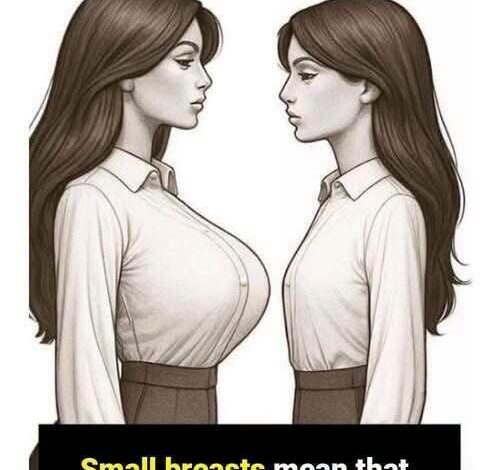
For many people, the greatest struggle is not their body itself, but the beliefs they have absorbed about it. Messages from culture, advertising, social media, and everyday conversations can suggest that some body types are more attractive, more feminine, or more deserving of admiration than others. When repeated often enough, those ideas can begin to feel true, even though beauty standards are constantly changing.
With time, many people begin to see things differently.
Instead of asking, “What is wrong with my body?” they start asking a more revealing question: “Who taught me to think my body was not enough?”
That change in perspective can be deeply liberating.
Breast size, like height, eye color, or foot size, is simply one form of natural human variation. It does not determine femininity, confidence, attractiveness, or personal worth. Bodies differ because of genetics, hormones, age, weight changes, pregnancy, and many other biological factors. There is no medically defined “perfect” size, and history shows that standards of beauty vary widely across cultures and generations.
From a physical standpoint, breast size alone reveals very little. Breasts differ not only in size, but also in tissue composition, skin elasticity, muscle support, and nerve distribution. Comfort, sensitivity, and function vary greatly from person to person and cannot be predicted by cup size.
As the body changes over time, overall health, posture, strength, and comfort often matter far more than trying to match an imagined ideal. Wearing clothing that feels good and reflects your personality can become an act of self-expression rather than an attempt to hide or “fix” your appearance.
Just as important, attraction has never followed a single formula. People are drawn to an extraordinary range of body types, personalities, and physical features. What one person barely notices, another may find beautiful. Attraction is influenced by individual preference, culture, emotional connection, confidence, and countless other factors that cannot be reduced to measurements.
Of course, insecurities do not disappear instantly.
But recognizing that many of them come from unrealistic or ever-changing beauty standards can make it easier to replace self-criticism with self-acceptance.
Your body is not a problem waiting to be solved.
It is the body that carries you through life. It breathes, heals, adapts, holds the people you love, and allows you to experience the world in ways no trend or advertisement can define.
When you begin to view yourself through that broader perspective, comparison loses much of its power. The question is no longer whether your body meets someone else’s expectations. The more meaningful question becomes whether you are learning to value it for what it already is: unique, capable, deserving of care, and unmistakably your own.