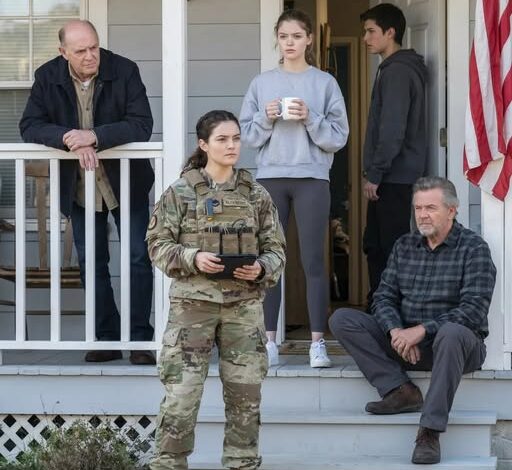
The Homecoming
The taxi driver barely spoke during the forty-minute ride from Sea-Tac Airport to my neighborhood, and I was grateful for it.
After thirteen hours in the air from Okinawa, followed by a layover in San Francisco that seemed to last forever, conversation was the last thing I wanted. Exhaustion sat heavy behind my eyes as I leaned against the window and watched western Washington slide past.
The landscape was exactly as I remembered.
Towering evergreens lined the highways like silent guardians. Low gray clouds hung overhead, threatening rain that never seemed to arrive. Familiar neighborhoods stretched across the horizon, though there were noticeably more houses than when I had left six months earlier.
Beside me sat my seabag.
Everything that mattered fit inside that worn olive-green canvas.
Uniforms.
Photographs.
Letters.
A small wooden box my mother had given me before she passed away, containing her wedding ring and a handwritten note I still couldn’t bring myself to read again.
The rest of my life waited at home.
Or at least I believed it did.
For six months, that house had existed in my mind like a destination on the other side of a storm.
The first home I had ever truly owned.
The house I bought with deployment money and years of sacrifice.
The place I rebuilt room by room with my own hands.
I installed the floors myself.
Painted every wall.
Built the deck.
Fixed mistakes I made along the way and learned new skills because hiring professionals cost more than I could afford.
That house wasn’t just property.
It was proof.
Proof that all the missed holidays, lonely deployments, and years of military life had built something permanent.
Something that belonged to me.
During sleepless nights in Okinawa, when the humid air pressed against the barracks walls and cicadas screamed outside until dawn, I thought about coming home.
When work dragged endlessly through repetitive shore-duty routines, I thought about coming home.
When loneliness hit hardest, I thought about coming home.
The house became a symbol of normal life waiting patiently for me.
A reward for enduring another six months away.
Still, something had felt wrong for weeks.
I couldn’t explain it.
Every conversation with my father left me uneasy.
Whenever we video-called, he seemed distracted.
Guarded.
Like he was hiding something just beyond the edge of the camera.
He smiled too quickly.
Changed subjects too often.
Avoided direct answers.
At first I blamed the distance.
Then I blamed my imagination.
Eventually I stopped looking for explanations.
But the feeling never disappeared.
It sat quietly in the back of my mind like a storm gathering offshore.
The taxi turned onto my street.
For the first time all day, I smiled.
Home.
Finally.
The driver pulled toward the curb.
I reached for my wallet.
And then I saw them.
Standing on my porch.
My father.
And my older brother, Chad.
The moment I saw them, my stomach dropped.
Not because they were there.
Because of how they were standing.
People who are happy to see you don’t look like that.
My father stood with his arms crossed tightly against his chest.
Chad leaned casually against the railing with a beer in his hand despite it being barely ten in the morning.
Both wore expressions that instantly killed the excitement I had carried across an ocean.
They weren’t waiting to welcome me home.
They were waiting for something else.
Something bad.
I paid the driver, grabbed my seabag, and started up the walkway.
Each step felt heavier than the last.
The closer I got, the stronger that familiar feeling became.
The same instinct that had warned me something was wrong weeks ago.
The same instinct I had ignored.
I reached the edge of the yard.
My father spoke before I could.
“You’re homeless now.”
The words hit harder than any punch.
For a second, I genuinely thought I had misheard him.
No welcome home.
No how was the flight.
No good to see you.
Just four words.
Cold.
Flat.
Casual.
As if he were commenting on the weather.
I stopped walking.
My seabag slid slightly from my shoulder.
“What are you talking about?” I asked.
My voice surprised even me.
Calm.
Controlled.
The voice Marines learn to use when panic isn’t an option.
Chad laughed.
That familiar laugh.
The same one he had used my entire life whenever he thought I was being stupid.
“We sold your house, sis,” he said.
“Try to keep up.”
Then both of them laughed.
Actually laughed.
As if the situation were funny.
As if stealing someone’s home was a joke.
As if six months of serving overseas somehow made me less entitled to my own life.
My father pointed lazily toward the front door.
“Your brother needed help.”
He shrugged.
“Family sacrifices for family.”
Then came the sentence that changed everything.
“You weren’t here. You didn’t need it.”
A strange calm settled over me.
Not anger.
Not yet.
Something colder.
Sharper.
The same mental clarity I’d felt during emergencies and crisis situations.
The kind that arrives when emotions become distractions.
I should have screamed.
Should have demanded answers.
Should have broken down.
That was probably what they expected.
Instead, I smiled.
Slowly.
Deliberately.
Both of them stopped laughing.
The change was immediate.
Confusion replaced confidence.
My father frowned.
Chad lowered his beer.
Neither of them understood why I wasn’t reacting the way they expected.
“What’s so funny?” my father asked.
I looked at him.
Then at my brother.
Then at the house they thought they’d stolen.
“The house you sold,” I said quietly, “wasn’t actually yours to sell.”
For the first time that morning, neither of them had anything to say.