What began as one of Washington’s most anticipated political and media gatherings quickly transformed into an evening of fear, confusion, and emergency response.
On the night of April 25, 2026, the annual White House Correspondents’ Association Dinner was underway at the Washington Hilton in Washington, D.C. Journalists, government officials, media executives, and invited guests filled the ballroom for an event traditionally known for its mix of politics, journalism, and ceremony. Among those attending were President Donald Trump, First Lady Melania Trump, and several senior administration officials.
Inside, the atmosphere reflected the usual rhythm of the evening. Conversations flowed between tables, cameras captured notable arrivals, and guests settled in for a night that was expected to follow a familiar script.
That expectation shattered within moments.
According to authorities, a serious security incident unfolded near one of the protected access points surrounding the venue. Law enforcement officials later identified the suspect as 31-year-old Cole Tomas Allen, who allegedly attempted to breach a security checkpoint positioned close to the ballroom. The checkpoint formed part of the extensive security perimeter established around the event due to the presence of high-ranking government officials and other protected individuals.
The attempted breach immediately triggered a response from Secret Service agents and supporting law enforcement personnel stationed throughout the property.
What followed was a rapidly escalating confrontation.
Officials reported that gunfire was exchanged during the incident, and one Secret Service agent was struck. Authorities later confirmed that the agent survived because a ballistic vest absorbed the impact, preventing potentially life-threatening injuries. Emergency medical personnel responded immediately, and the agent was transported for evaluation before being listed in stable condition.
Inside the ballroom, the mood changed almost instantly.
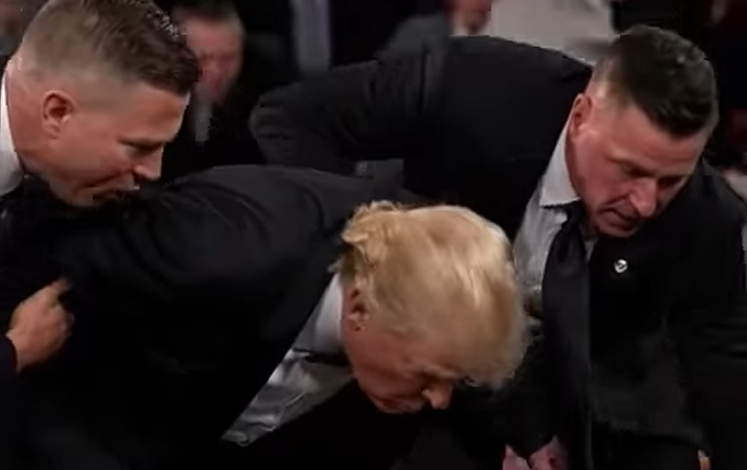
Protective details moved with urgency as security teams surrounded President Trump and other senior officials. Guests watched as agents coordinated evacuation procedures and secured key areas of the hotel. Portions of the building were placed under lockdown while officers worked to determine the scope of the threat.
What had moments earlier been a formal evening of speeches and celebration suddenly became a scene defined by uncertainty.
Many attendees initially struggled to understand what was happening. Conversations stopped. Guests exchanged confused glances. Security personnel issued instructions as law enforcement activity intensified outside the ballroom.
President Trump was safely removed from the venue and transported to a secure location.
Later, in remarks to the public, he praised the actions of the Secret Service and law enforcement officers involved in the response. He specifically acknowledged the injured agent, noting that the officer was alert and recovering, and credited security personnel with preventing a far more serious outcome.
Organizers subsequently canceled the remainder of the evening’s program, citing safety concerns for attendees, staff, and security personnel. Discussions regarding a future rescheduled event were announced, though officials indicated that any decisions would depend on the findings of the ongoing investigation and a broader review of security protocols.
Federal investigators quickly launched a comprehensive inquiry.
The Secret Service and the FBI began examining the suspect’s background, movements, communications, and possible motivations. Investigators collected surveillance footage, interviewed witnesses, and analyzed forensic evidence from the scene as they worked to determine how the suspect approached the checkpoint and whether additional individuals may have been involved.
Early indications suggested the possibility that government officials attending the dinner may have been the intended focus of the attack, though investigators emphasized that the inquiry remained active and that conclusions would depend on the evidence collected.
The location itself added another layer of significance to the incident.
The Washington Hilton occupies a unique place in American political history as the site of the 1981 assassination attempt against President Ronald Reagan. For many observers, the events of April 25 revived memories of that earlier tragedy and underscored the continuing security challenges surrounding high-profile public events.
For journalists attending the dinner, the experience carried a particularly unusual dimension.
They arrived expecting to report on the evening’s speeches, political messaging, and social interactions. Instead, they became firsthand witnesses to a major security incident.
Many later described the sudden transition from routine conversation to emergency procedures as deeply unsettling. Several reporters recalled hearing urgent instructions from security personnel without immediately understanding the reason. Others described the confusion of watching protective teams move rapidly through the venue while information remained limited.
Videos and personal accounts shared afterward captured the uncertainty that gripped the ballroom. Guests waited for updates as law enforcement secured the property and officials worked to assess the situation.
In the end, what was meant to be one of Washington’s most familiar annual traditions became something entirely different.
The evening served as a reminder that even the most carefully protected events can be disrupted without warning. It highlighted the speed with which ordinary moments can become extraordinary crises and demonstrated the critical role played by the security professionals tasked with protecting public officials and large gatherings.
For those who were present, the memories of that night would extend far beyond the speeches that were never delivered.
What began as a celebration of politics and journalism became a stark illustration of vulnerability, preparedness, and the fragile line that often separates routine public life from unexpected danger.