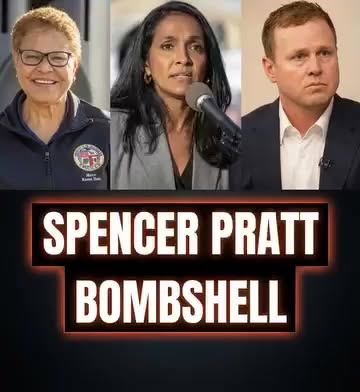
What was once viewed as one of the most reliable political strongholds in the United States is now showing signs of growing voter unease. In Los Angeles—a city that has traditionally favored Democratic leadership—the latest mayoral runoff is becoming about far more than two competing candidates. For many residents, the election has evolved into a referendum on the city’s direction and a broader assessment of whether local leadership is effectively addressing the challenges reshaping everyday life.
Mayor Karen Bass remains the frontrunner, but her position has not generated the sense of confidence many expected. Rather than cruising toward reelection, she faces an electorate that appears increasingly frustrated, skeptical, and divided. Across the city, conversations are focusing less on partisan identity and more on concerns that residents encounter firsthand: homelessness, public safety, drug addiction, wildfire preparedness, rising business costs, and the overall quality of life.
These issues have fueled a growing perception that Los Angeles is struggling to keep pace with its own ambitions.
Into that environment has stepped Spencer Pratt, a candidate whom many political observers initially dismissed as an unlikely contender. Known more for his public profile than for political experience, Pratt was widely viewed as a long-shot candidate when the race began. Yet as dissatisfaction with city leadership intensified, he began attracting support from voters who felt overlooked by traditional politicians.
What once appeared to be a symbolic campaign has gained unexpected momentum.
For many of his supporters, Pratt’s appeal lies not in government experience but in his outsider status. They see him as someone willing to challenge political norms and question a system they believe has become disconnected from everyday concerns. His direct and often confrontational style has resonated with voters who are increasingly skeptical of polished messaging and incremental promises.
To these residents, the city’s challenges are no longer abstract policy discussions. They are visible in neighborhoods, reflected in struggling businesses, and felt through concerns about safety, affordability, and public services.
The campaign intensified further when Pratt filed a formal complaint alleging that Bass engaged in improper election-related activity near a ballot drop box. The allegation quickly became a flashpoint in an already heated race.
Pratt’s supporters argue that the complaint reflects a broader concern about accountability and oversight. They believe powerful political figures should face the same scrutiny as everyone else and see the controversy as part of a larger conversation about transparency in public life.
Bass’s campaign has strongly rejected the claims, characterizing the complaint as a political tactic designed to generate attention and energize Pratt’s supporters. Campaign officials argue that governing a city as large and complex as Los Angeles requires long-term solutions and that many of the city’s most difficult problems developed over decades rather than a single administration.
Yet the controversy continues to resonate because it taps into a deeper sentiment among voters.
Increasingly, the runoff appears to be driven less by enthusiasm for a particular candidate and more by dissatisfaction with existing institutions. Residents who once voted predictably along party lines are now asking tougher questions about performance, effectiveness, and accountability.
Long-standing political assumptions suddenly appear less certain.
Beneath the campaign advertisements and public appearances lies a broader debate about what Los Angeles should be moving forward. For generations, the city has projected an image of opportunity, innovation, and cultural influence. Today, however, many residents worry that rising costs, persistent homelessness, public safety concerns, and economic pressures are challenging that vision.
Opinions differ on whether conditions are improving or worsening, but few dispute that these issues remain central to the public conversation.
As a result, the runoff has become more than a contest between Karen Bass and Spencer Pratt.
It has become a reflection of a city grappling with uncertainty.
One side argues that experience, continuity, and steady leadership offer the best path forward. The other contends that longstanding problems require new voices, fresh approaches, and a willingness to challenge established political structures.
Caught between those competing visions are millions of residents trying to decide not only who should lead Los Angeles, but what future they want the city to pursue.
As election day approaches, one reality is becoming increasingly difficult to ignore: the political certainty that once defined Los Angeles no longer feels guaranteed.
Polling may indicate a competitive race, but the atmosphere surrounding it could prove even more significant. Beneath the numbers lies a growing sense that voters are reconsidering old loyalties and reevaluating assumptions that once seemed permanent.
Whether Bass ultimately secures another term or Pratt completes an unexpected political rise, the broader message emerging from this election is clear.
Los Angeles is searching for answers.
And many voters are no longer certain where those answers will come from—or who they trust to provide them.