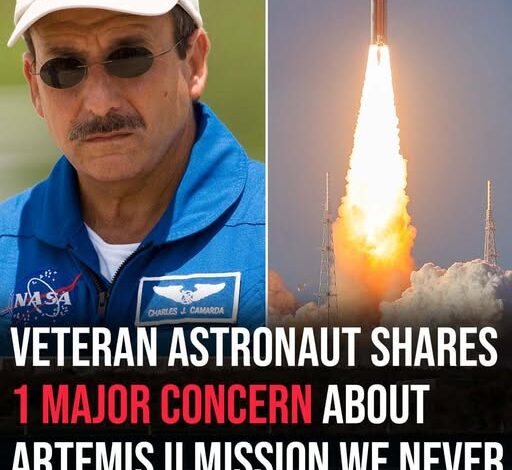
As NASA moves closer to launching the Artemis II mission, anticipation is growing around what many see as the beginning of a new era in human space exploration. The mission is expected to send astronauts farther from Earth than any crew has traveled in decades, marking a major step toward returning humans to the Moon and eventually establishing a sustained presence beyond our planet.
Yet amid the excitement, some voices within the aerospace community are urging caution.
Among them is Charles Camarda, a former NASA astronaut and aerospace engineer whose experience has given him a unique perspective on the challenges of human spaceflight. Having flown on NASA’s first Space Shuttle mission following the Columbia disaster, Camarda witnessed firsthand how organizational decisions can carry consequences as significant as technical failures.
His concerns are not focused solely on rockets, spacecraft, or engineering systems.
Instead, he believes one of the greatest risks facing any space program lies within the culture of the organization itself.
According to Camarda, history has shown that danger often emerges not from obvious failures, but from the gradual normalization of problems that appear manageable. When issues repeatedly occur without causing immediate disaster, organizations can become accustomed to them, viewing warning signs as routine rather than recognizing them as potential threats.
This pattern, he argues, contributed to both the Challenger and Columbia tragedies.
In each case, warning indicators were present long before catastrophe struck. Over time, however, those concerns became accepted as part of normal operations, creating a false sense of confidence that ultimately proved devastating.
For Camarda, the lesson remains highly relevant today.
Artemis II is expected to carry four astronauts on a journey around the Moon before returning safely to Earth. The mission will serve as the first crewed test of NASA’s Orion spacecraft and the Space Launch System (SLS), two critical components of the agency’s broader lunar exploration strategy.
NASA officials have repeatedly expressed confidence in the program and the extensive testing that has preceded the mission.
Camarda agrees that confidence is important.
But he believes confidence must always be balanced by skepticism.
In his view, every anomaly, unexpected result, or technical concern deserves careful examination, regardless of how minor it may appear. Small issues, he argues, can sometimes reveal deeper vulnerabilities that might otherwise remain hidden until far more serious consequences emerge.
His concerns also extend beyond engineering.
Large organizations often face competing pressures, including political expectations, budget constraints, public scrutiny, and ambitious schedules. While these factors are unavoidable, Camarda warns that they can sometimes influence decision-making in ways that unintentionally diminish the role of engineering judgment.
When meeting deadlines becomes a higher priority than questioning assumptions, he argues, organizations become vulnerable.
The Space Launch System itself represents one of the most powerful launch vehicles ever developed, incorporating both modern technologies and systems derived from decades of NASA experience. While its capabilities are widely recognized, Camarda believes that every component must continue to be scrutinized with the same intensity applied during the earliest stages of development.
To him, safety is not a milestone that can be completed.
It is a continuous process.
Despite his warnings, Camarda remains deeply supportive of NASA’s mission and its future ambitions. His criticism is not rooted in opposition to exploration, but in a desire to ensure that exploration proceeds as safely as possible.
He advocates for an environment where engineers feel empowered to challenge assumptions, raise concerns without hesitation, and question decisions regardless of organizational hierarchy. Such openness, he believes, is essential to preventing the kinds of failures that have shaped some of NASA’s most difficult chapters.
The Artemis II crew—Reid Wiseman, Victor Glover, Christina Koch, and Jeremy Hansen—embodies the next generation of explorers prepared to venture into deep space. Camarda has expressed admiration for their dedication and courage, while emphasizing that even the most capable astronauts depend on the systems, processes, and decisions made long before launch day.
Bravery alone cannot eliminate risk.
Only preparation can.
History has repeatedly demonstrated that major accidents rarely stem from a single mistake. More often, they emerge from a chain of overlooked concerns, small compromises, and assumptions that previous success guarantees future safety.
That is the pattern Camarda believes NASA must guard against as Artemis II approaches.
As humanity prepares to take another step into deep space, his message serves as a reminder that exploration is not driven solely by technological achievement. It also depends on discipline, transparency, accountability, and a willingness to learn from past mistakes.
Whether one agrees fully with his concerns or not, the principle behind them remains difficult to dispute.
In spaceflight, the smallest overlooked detail can carry enormous consequences.
And as history has shown, the difference between triumph and tragedy is often determined long before a rocket ever leaves the launch pad.