The Girl in the Mud: The Heart-Wrenching Truth Behind the World’s Most Controversial Photograph

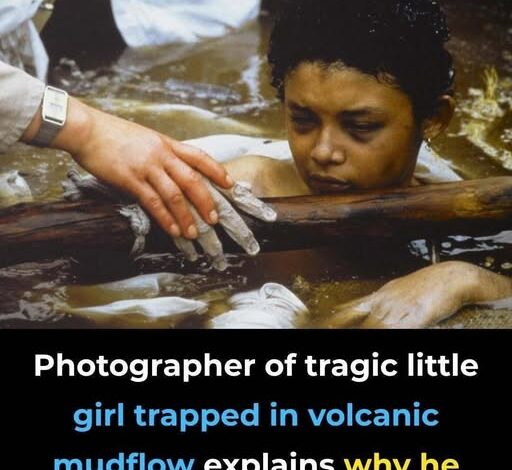
She was only thirteen years old.
Trapped beneath a mountain of volcanic mud and debris, unable to move, she spent her final days staring into a world that could see her suffering but could not save her. Her name was Omayra Sánchez, and in November 1985 she became the unforgettable face of one of the deadliest natural disasters in modern history.
For nearly three days, she remained pinned beneath the wreckage of her home after the catastrophic eruption of Colombia’s Nevado del Ruiz volcano. While rescue teams struggled desperately around her, cameras captured a heartbreaking image that would travel across the globe—a photograph that continues to provoke debate decades later.
Was the photographer documenting a tragedy the world needed to witness?
Or was he capturing the final moments of a dying child who deserved privacy instead of publicity?
The question remains controversial, but Omayra’s story reaches far beyond a single photograph.
It is a story of courage, loss, and a disaster that many believe should never have claimed so many lives.
On November 13, 1985, Nevado del Ruiz erupted after months of warnings from scientists and volcanologists. Although the eruption itself was relatively moderate, its consequences were devastating. Heat from the volcano melted glaciers high on the mountain, unleashing enormous mudflows known as lahars—fast-moving rivers of water, ash, rock, and volcanic debris.
The town of Armero stood directly in their path.
Within hours, wave after wave of mud crashed through the community, destroying homes, roads, businesses, and entire neighborhoods. Thousands of residents had little or no warning.
By morning, Armero had effectively disappeared.
Nearly 25,000 people lost their lives.
It remains one of the deadliest volcanic disasters of the twentieth century.
Among the survivors initially pulled from the devastation was thirteen-year-old Omayra Sánchez.
Rescuers soon discovered that although she was alive, she was trapped.
Her legs were pinned beneath the remains of her collapsed home, entangled in concrete, debris, and submerged wreckage hidden beneath the muddy water surrounding her. The body of a relative was reportedly trapped beneath her as well, making extraction even more difficult.
Emergency crews worked tirelessly.
They searched for solutions.
They tried lifting debris.
They considered pumping away water.
They explored every possibility available to them.
But the resources needed to save her simply did not exist at the disaster site.
Any attempt to force her free risked causing catastrophic injuries or collapsing additional debris onto her body.
As hours turned into days, rescuers faced a heartbreaking reality.
They could comfort her.
They could stay beside her.
But they could not save her.
Throughout the ordeal, Omayra displayed extraordinary composure.
Despite severe pain, exhaustion, and growing physical deterioration, she remained remarkably calm. Journalists, rescue workers, and volunteers spoke with her, brought her small amounts of food and drink, and tried to keep her spirits alive.
She answered questions politely.
She smiled occasionally.
She thanked those trying to help.
She worried about missing school.
At one point, she reportedly spoke about an upcoming mathematics exam, concerned about responsibilities that suddenly seemed so ordinary compared to the tragedy surrounding her.
As the third night approached, the effects of prolonged exposure, infection, and exhaustion became increasingly visible.
Her eyes grew darker.
Her body weakened.
Hallucinations began to appear.
Yet even then, she continued thinking of others.
Witnesses recalled moments when she encouraged exhausted rescuers to rest, displaying a level of selflessness that seemed impossible for someone enduring such suffering.
Her final words to her family reflected that same love and grace.
She told them she loved them.
Then, after nearly seventy-two hours of unimaginable endurance, her body finally gave out.
On November 16, 1985, Omayra Sánchez died.
The image most people remember was taken during those final hours by French photojournalist Frank Fournier.
The photograph showed her face emerging from the muddy water, her eyes filled with exhaustion, courage, and resignation.
The picture quickly spread around the world.
Millions saw it.
Millions were moved by it.
And millions debated whether it should ever have been taken.
Critics argued that photographing a dying child crossed an ethical line. Some accused Fournier of exploiting tragedy for professional recognition. Others questioned why a camera had been raised instead of another rescue attempt being made.
Fournier strongly rejected those accusations.
He maintained that there was no realistic way he could have saved Omayra and that the people present had already exhausted every available option. In his view, the photograph served a greater purpose.
It showed the world what had happened.
It exposed the scale of the disaster.
And it drew attention to failures that many believed contributed to the catastrophe.
The eruption itself was a natural event.
But the scale of the loss was not.
Investigations later revealed that warnings about the volcano had been issued before the disaster. Scientists had identified the risk. Hazard maps had been created. Concerns had been raised.
Yet evacuation plans were inadequate, communication was inconsistent, and many residents remained unaware of the danger until it was far too late.
For many observers, Omayra became more than a victim.
She became a symbol.
A symbol of lives lost because warnings were not acted upon.
A symbol of the human cost of bureaucratic failure.
A symbol of courage in the face of overwhelming tragedy.
Decades later, her story continues to resonate because it forces difficult questions.
What responsibility do governments have when warnings are ignored?
What role should journalists play during moments of extreme suffering?
How should society remember victims of disasters?
And how do we balance the need to document history with the dignity of those living through it?
Frank Fournier has often said that the image continues to affect people because of the strength visible in Omayra’s face.
He believed the photograph connected a forgotten tragedy to the conscience of the world.
Whether one agrees with that decision or not, the impact of the image is undeniable.
Today, Omayra Sánchez remains one of the most recognizable faces associated with humanitarian tragedy.
Not because of how she died.
But because of how she endured.
In her final hours, she displayed a level of courage that continues to move people across generations and continents.
The volcano took her life.
The disaster destroyed her town.
But her story survived.
And through that story, the world is reminded of the devastating consequences of inaction, the importance of accountability, and the extraordinary resilience that can exist even in humanity’s darkest moments.
Omayra’s voice was eventually silenced by the mud that surrounded her.
Yet her image continues to speak.
And decades later, the world is still listening.