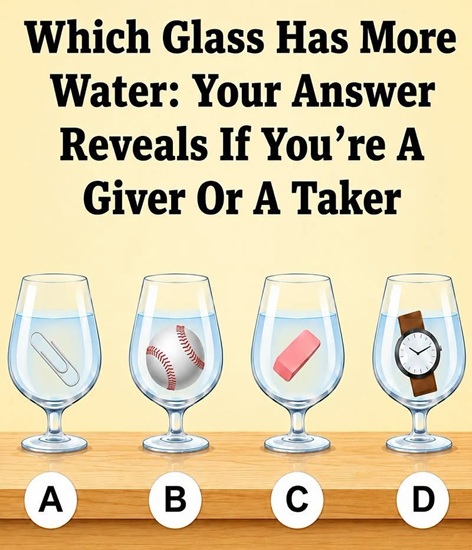
At first glance, this looks like a simple puzzle designed for children, but it has managed to confuse thousands of adults online. Four identical glasses sit side by side, each appearing to contain exactly the same amount of water. Inside each glass, however, is a different object. The challenge is straightforward: which glass actually contains the most water?
Most people answer within seconds, convinced the solution is obvious. Yet this deceptively simple puzzle reveals something fascinating about how the human mind works. The correct answer is not determined by what your eyes see at first glance, but by understanding a basic principle of physics that many people overlook.
The four glasses are labeled A, B, C, and D. Each glass is filled to the same visible water level. Glass A contains a small paperclip, Glass B contains a baseball, Glass C contains an eraser, and Glass D contains a wristwatch. Because the water reaches the same height in every glass, our brains naturally assume they all contain equal amounts of water.
That assumption is exactly where most people go wrong.
The puzzle exploits a mental shortcut known as visual approximation. Our brains are designed to process information quickly, often relying on appearance rather than careful analysis. When we see identical containers filled to identical levels, we instinctively categorize them as equal. It’s an efficient way of thinking, but it ignores an important factor hiding beneath the surface.
That factor is displacement.
According to the principle of displacement, any object placed into water occupies space and pushes some of that water aside. The larger the object, the more space it takes up inside the glass. Since all four glasses are filled to the same level, the objects themselves account for part of the volume we see.
This means the actual amount of water depends on how much room remains after the object is submerged.
Once you look at the puzzle this way, the answer becomes clear.
The baseball in Glass B occupies the most space, meaning it displaces the greatest amount of water. The wristwatch in Glass D and the eraser in Glass C also take up a noticeable volume inside their glasses. The paperclip in Glass A, however, is tiny by comparison. It occupies very little space and therefore displaces the least amount of water.
As a result, Glass A contains the largest volume of actual water.
Although all four glasses appear equally full, Glass A holds more water because its object takes up the least amount of space.
What makes this puzzle so effective is how it highlights the difference between perception and reality. Our eyes tell us one thing, but logic and physics reveal another. The brain often favors speed over accuracy, making quick judgments based on appearances. Most of the time that works well. Occasionally, however, it leads us straight into a trap.
This is one reason puzzles like this spread so rapidly online. They create a moment of surprise. People answer confidently, only to discover they overlooked a crucial detail. That brief realization is both humbling and satisfying because it reminds us that things are not always what they seem.
Some people enjoy adding personality interpretations to puzzles like this. While these descriptions are purely for entertainment and have no scientific basis, they can make the experience more engaging.
Those who choose Glass A are often described as analytical thinkers who pay close attention to details that others miss. People who select Glass B may be seen as confident decision-makers who trust their instincts and focus on the bigger picture. Choosing Glass C is sometimes associated with balanced thinkers who combine logic with intuition, while Glass D is often linked to reflective individuals who enjoy exploring deeper meanings and possibilities.
Whether those descriptions are accurate or not, they add another layer of fun to the puzzle.
More importantly, the puzzle offers a valuable lesson that extends beyond glasses of water and submerged objects. In everyday life, appearances can be misleading. People frequently make decisions based on first impressions, surface-level information, or assumptions that seem obvious. Yet a closer examination often reveals hidden details that completely change the situation.
The tiny paperclip in Glass A serves as a perfect reminder of that reality.
Sometimes the smallest detail has the biggest impact.
The next time something appears obvious, it may be worth taking a second look. Ask yourself what factors might be hidden beneath the surface. Consider what information you may be overlooking. A little extra analysis can often lead to a completely different conclusion.
That is the real beauty of puzzles like this. They are not just tests of observation; they are exercises in critical thinking. They challenge us to slow down, question assumptions, and look beyond appearances.
In the end, the correct answer is Glass A. But the bigger lesson is that reality is not always determined by what we see first. Often, the truth lies in the details we almost missed.