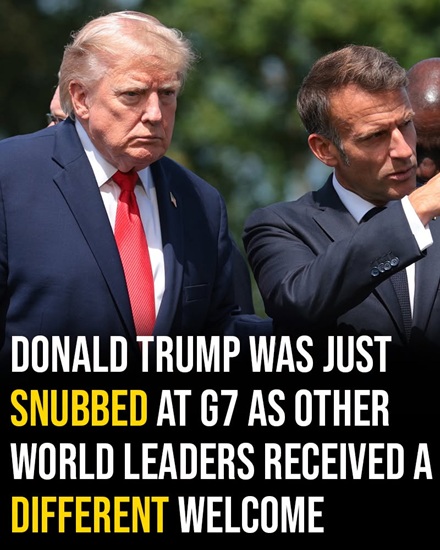
At the G7 summit, Donald Trump appeared to receive a different reception compared to other world leaders, drawing attention online.

President Donald Trump attracted significant attention during the Group of Seven (G7) summit in Evian-les-Bains, France, where world leaders gathered to address some of the most pressing political, economic, and security challenges facing the international community. The summit brought together leaders from Canada, France, Germany, Italy, Japan, the United Kingdom, and the United States, while several invited nations and international organizations also participated in selected discussions.
Although Ukraine is not a member of the G7, Ukrainian President Volodymyr Zelensky was invited to attend portions of the summit, underscoring the continued international focus on the war in Ukraine. Other invited partners, including representatives from Brazil, India, Kenya, and South Korea, joined discussions centered on global cooperation, economic stability, trade, and security.
As leaders arrived for one of the summit’s key working sessions, cameras captured President Trump entering the venue slightly ahead of French President Emmanuel Macron and President Zelensky. Upon reaching the meeting area, Trump briefly paused near a large central conference table, appearing to survey the room before other leaders gathered nearby. The footage quickly circulated online, drawing attention to the interactions among the attending heads of state.
Interest intensified when European Commission President Ursula von der Leyen entered the room. Video footage showed her greeting President Trump with a handshake and a brief exchange before continuing through the gathering. Moments later, she greeted President Macron with a warmer interaction that included a smile and a traditional double-cheek greeting, a common diplomatic custom in many European countries.
Additional images from the summit showed von der Leyen embracing several leaders, including President Zelensky and Canadian Prime Minister Mark Carney, in similarly friendly exchanges. These differences in greeting styles became a topic of discussion among observers and generated considerable commentary across news outlets and social media platforms.
Earlier in the summit, President Trump discussed recent international developments during a bilateral meeting, noting that he had spoken with both President Zelensky and Russian President Vladimir Putin. He suggested that following other urgent global matters, diplomatic attention would increasingly focus on efforts related to the conflict in Ukraine and broader international negotiations.
Beyond Ukraine, the summit agenda covered a wide range of global concerns. Leaders addressed issues including energy security, economic stability, international trade, and growing tensions in the Middle East. Discussions focused on the impact of regional conflicts on global energy markets, supply chains, and maritime trade routes.
Representatives from countries including Egypt, Qatar, and the United Arab Emirates were expected to participate in sessions concerning Middle Eastern diplomacy. These conversations centered on reducing regional tensions, improving humanitarian conditions, and exploring opportunities for long-term stability.
The summit also unfolded amid ongoing policy disagreements between the United States and several European allies. Reports indicated that differing views on recent U.S. foreign policy decisions, particularly regarding developments in the Middle East, contributed to a more cautious diplomatic atmosphere during certain meetings and discussions.
Despite these differences, leaders repeatedly emphasized the importance of cooperation when addressing shared international challenges. Prior to the summit, France, Germany, Italy, the United Kingdom, and Canada released a joint statement welcoming recent diplomatic efforts involving the United States, Iran, and international mediators. The statement described those developments as a potential opportunity to support regional stability and strengthen confidence in the global economy.
The leaders stressed that continued dialogue and diplomacy would remain essential to ensuring that any future agreements are implemented effectively and sustained over time. They also highlighted the strategic importance of maintaining secure and open international trade routes, particularly through the Strait of Hormuz, one of the world’s most important energy corridors.
The joint statement reaffirmed support for freedom of navigation and maritime security in the region. Participating nations expressed their willingness to coordinate efforts aimed at protecting shipping routes and maintaining regional stability, while operating within their respective legal and constitutional frameworks.
Overall, the G7 summit demonstrated both the strengths and challenges of modern international diplomacy. While leaders shared concerns about global instability and expressed a willingness to work together on major issues, subtle differences in personal interactions and policy priorities also reflected the complex realities of maintaining unity among the world’s leading powers. As the summit concluded, it left behind a reminder that cooperation remains essential, even when perspectives and approaches differ.