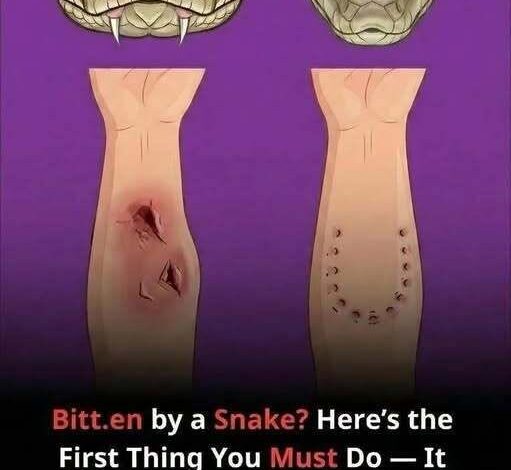
Most people never think about snakebites until they hear a sudden rustle in the grass.
One moment, you’re enjoying an ordinary day outdoors—working in the garden, hiking a familiar trail, gathering firewood, or walking across your property.
The next, something moves near your feet.
Your heart jumps.
And for a split second, nothing else matters.
Most encounters end harmlessly.
The snake disappears.
You take a breath.
Life continues.
But not every encounter ends that way.
And when it doesn’t, knowing what to do can make all the difference.
For thousands of years, snakes and humans have shared the same landscapes. They inhabit forests, fields, deserts, wetlands, farms, and suburban neighborhoods. Despite their reputation, most snakes are not aggressive. They don’t hunt people, and they rarely seek confrontation.
In fact, most snakes would rather flee than fight.
The problem is that accidental encounters happen.
A snake hidden beneath a pile of firewood.
One resting quietly in tall grass.
Another concealed beside a garden shed.
A startled snake surprised by a hiker stepping too close.
In these situations, both human and snake can react suddenly—and sometimes that reaction results in a bite.
Because some species carry venom capable of causing serious injury or death, understanding snake safety is essential for anyone who spends time outdoors.
The encouraging news is that many snakebites are preventable.
Even better, modern medical treatment has dramatically improved survival rates and recovery outcomes.
Still, preparation remains one of the most valuable tools a person can have.
The greatest challenge during a snakebite emergency is often not the bite itself.
It’s panic.
When people become frightened, their heart rate rises. Breathing becomes rapid. Decisions become rushed. Movement becomes uncontrolled.
If venom has entered the body, excessive movement may help it spread more quickly through the lymphatic system.
That’s why experts consistently emphasize a simple but powerful principle:
Stay calm.
Fear is natural.
Panic is dangerous.
Every year, health authorities around the world respond to thousands of snakebite incidents. Countries throughout North and South America, Australia, Africa, and Asia regularly report encounters involving venomous species.
One of the most important things to understand is that symptoms can vary dramatically.
Some venomous bites cause immediate pain and swelling.
Others produce very little discomfort at first.
In certain cases, a person may initially feel fine before developing serious symptoms hours later.
Dizziness.
Weakness.
Nausea.
Blurred vision.
Difficulty breathing.
Neurological changes.
Because appearances can be misleading, every snakebite should be treated as a medical emergency until qualified professionals determine otherwise.
Many people imagine snake encounters happening deep in remote wilderness.
The reality is often much closer to home.
Homeowners discover snakes while mowing lawns.
Gardeners encounter them while pulling weeds.
Residents find them beneath outdoor furniture, inside sheds, or around stacked lumber.
Children sometimes spot them near fences, flower beds, or play areas.
Even routine household tasks can lead to unexpected encounters.
Understanding why snakes enter certain areas can help reduce the risk.
Like all animals, snakes are searching for basic necessities.
Shelter.
Food.
Water.
Warmth.
Tall vegetation provides cover.
Woodpiles offer protection.
Storage materials create hiding places.
And where rodents thrive, snakes often follow.
A property that attracts mice and rats may unintentionally attract the predators that hunt them.
Fortunately, reducing risk often requires only simple changes.
Keeping grass trimmed.
Removing clutter.
Organizing woodpiles.
Sealing openings beneath sheds and garages.
Reducing rodent activity.
These small actions can make a significant difference.
Personal habits matter too.
When walking in snake-prone areas, stay on clear paths whenever possible.
Avoid stepping blindly over logs, rocks, or dense vegetation.
Look first.
Move second.
The same principle applies to your hands.
Many bites occur when people reach into places they cannot see.
Garden beds.
Storage boxes.
Bushes.
Woodpiles.
Dark corners of sheds.
A few seconds of caution can prevent a painful and dangerous encounter.
Protective clothing also helps.
Many bites occur on the feet, ankles, lower legs, and hands.
Sturdy boots, long trousers, gloves, and thick socks create an additional layer of protection.
While no clothing can guarantee safety, proper gear can significantly reduce risk.
One of the most common causes of preventable snakebites is surprisingly simple:
People trying to handle snakes.
Many individuals underestimate how quickly a snake can strike.
Even a snake that appears calm can react instantly when threatened.
An injured snake may be even more unpredictable.
Countless bites occur not because the snake approached a person, but because the person approached the snake.
Attempting to catch, kill, provoke, or relocate a snake dramatically increases danger.
The safest response is usually the simplest one.
Back away slowly.
Keep children and pets away.
Allow the snake space to leave.
Contact trained wildlife professionals if removal is necessary.
Most snakes are perfectly willing to avoid conflict if given the opportunity.
Despite every precaution, bites can still happen.
When they do, the first priority is seeking emergency medical assistance immediately.
Then focus on limiting movement.
Keep the person calm.
Keep them still.
If possible, immobilize the affected limb.
Excessive movement should be avoided.
Walking should be minimized whenever possible.
Depending on local medical guidelines and the species involved, pressure immobilization techniques may be recommended in certain regions. These methods should only be used according to official health authority recommendations.
Just as important is understanding what not to do.
Movies, myths, and outdated advice have created dangerous misconceptions about snakebite treatment.
Do not cut the wound.
Do not attempt to suck out venom.
Do not apply ice.
Do not burn the bite area.
Do not drink alcohol.
Do not run.
Do not attempt dramatic self-treatment.
And do not apply a tourniquet unless specifically instructed by medical professionals.
These actions often cause more harm than good.
If it can be done safely, try to remember what the snake looked like.
However, never attempt to capture, kill, or photograph a snake if doing so puts you at risk of another bite.
Medical professionals have safer methods of identification.
Once medical care is available, doctors can monitor symptoms, perform diagnostic testing, administer antivenom when necessary, and provide supportive treatment.
Modern medicine has transformed snakebite survival rates.
Prompt treatment remains one of the most important factors influencing recovery.
Preparation is not about fear.
It’s about confidence.
Families living in snake-prone regions can discuss emergency plans.
Workers can receive proper training.
Hikers can carry basic first-aid supplies and share their routes.
Homeowners can make their properties less attractive to snakes.
Communities can promote awareness without creating panic.
Perhaps most importantly, people can learn to respect snakes without fearing them.
Snakes play an important role in ecosystems.
They help control rodent populations.
They contribute to environmental balance.
Most are not threats waiting to happen.
Most simply want to be left alone.
The goal is not to fear every snake.
The goal is to understand the risks, respect wildlife, and respond intelligently when encounters occur.
Gardens should remain places of peace.
Trails should remain places of adventure.
Farms should remain places of hard work and pride.
Outdoor life should remain enjoyable.
With awareness, preparation, and common sense, it can be.
And if a snakebite ever does occur, remember the basics:
Stay calm.
Call emergency services.
Keep the person still.
Follow proper first-aid guidance.
Seek professional medical care immediately.
The steps may sound simple.
But in a critical moment, they can mean the difference between panic and protection—and sometimes between tragedy and survival.