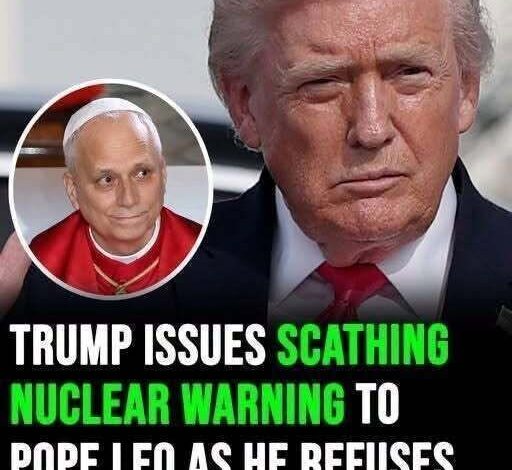
The exchange was brief.
Its significance was not.
When President Donald Trump publicly disagreed with Pope Leo’s appeal for diplomacy regarding tensions with Iran, the moment quickly drew global attention. What might have seemed like a simple political disagreement soon revealed something much larger—a clash between two very different philosophies about how nations should confront danger and preserve peace.
On one side stood a political leader who argued that strength, deterrence, and a firm response to potential threats remain essential to maintaining security.
On the other stood a spiritual leader who warned that relying too heavily on confrontation can sometimes increase the very risks nations hope to avoid.
What began as a dispute over Iran soon evolved into a broader conversation about power, diplomacy, and the future of international stability.
The disagreement emerged after Pope Leo urged restraint and renewed diplomatic efforts amid growing tensions in the Middle East. He cautioned that further escalation could carry serious consequences, not only for the region but for the wider international community.
President Trump viewed the situation differently.
He argued that an excessive focus on diplomacy may encourage governments pursuing dangerous objectives to believe there will be few consequences for their actions. From his perspective, maintaining a strong and credible posture toward Iran is a necessary part of preventing future instability and protecting global security.
Supporters of the President defended this approach as pragmatic and historically grounded.
They contend that strength often prevents conflict by discouraging aggression before it begins. In their view, deterrence is not an obstacle to peace but one of the primary conditions that allows peace to exist.
Without the possibility of meaningful consequences, they argue, diplomatic efforts may lose their effectiveness.
Pope Leo presented a contrasting vision.
Speaking during a public appearance, he emphasized a message that has become central to his leadership: lasting peace cannot be achieved through military power alone.
He encouraged nations to devote greater resources to improving human lives rather than expanding instruments of conflict. Investments in education, healthcare, development, and poverty reduction, he argued, create stronger foundations for long-term stability than weapons alone ever can.
His remarks were not directed solely at one government or one conflict.
They reflected a broader concern about a world increasingly defined by geopolitical competition, military buildups, and fears of wider confrontation.
The underlying message was clear: true security is not measured only by military capability but also by the strength of societies, institutions, and human well-being.
That perspective resonated with many who worry that continued escalation could lead to consequences beyond anyone’s control.
For decades, the Vatican has maintained a consistent position on these issues. Popes from different eras have repeatedly encouraged diplomatic solutions, warned against arms races, and emphasized the humanitarian costs of war.
The Church’s approach is rooted less in politics than in moral principle.
Its leaders have long argued that even conflicts fought for legitimate reasons often impose devastating burdens on civilians, families, and future generations.
Viewed in that context, Pope Leo’s comments followed a tradition that stretches back many decades.
Yet in today’s political climate, calls for diplomacy can be interpreted in dramatically different ways.
Critics argued that the Pope underestimated the dangers posed by hostile governments and armed groups. Some maintained that dialogue without sufficient pressure can embolden adversaries rather than restrain them.
Others responded that abandoning diplomacy risks creating cycles of confrontation that become increasingly difficult to escape.
The result is a debate that reaches far beyond any single dispute.
At its core lies one of the oldest questions in international affairs:
How can nations create security without creating greater insecurity?
History offers evidence for both sides.
There are moments when military strength has prevented conflict by discouraging aggression.
There are also moments when escalating displays of power have contributed to confrontation and war.
Likewise, diplomacy has produced remarkable breakthroughs throughout history while failing in other circumstances.
Determining which approach is most appropriate often depends on the unique challenges of a particular moment.
That is why the disagreement between Trump and Pope Leo attracted such widespread attention.
It reflects a larger debate taking place throughout the international community.
Governments today face a world marked by uncertainty. Regional conflicts continue to emerge. Nuclear concerns remain unresolved. Strategic rivalries are intensifying. New technologies have introduced new forms of warfare and new sources of instability.
In this environment, leaders often find themselves balancing two competing instincts.
One seeks security through strength.
The other seeks stability through dialogue.
Neither side views itself as opposing peace.
In fact, both claim to be pursuing the same objective.
That may be the most interesting aspect of the entire debate.
Trump and Pope Leo disagree not on whether peace matters, but on how peace is best preserved.
For Trump and his supporters, peace is protected when potential adversaries understand that hostile actions will carry serious consequences.
For Pope Leo and many of his supporters, peace is protected when nations prioritize communication, cooperation, and efforts to prevent conflict before violence occurs.
The goal is similar.
The strategy is very different.
That distinction helps explain why the conversation resonated so strongly around the world.
It touched on concerns shared by millions of people.
Concerns about war.
Concerns about instability.
Concerns about misunderstandings between powerful nations that could produce consequences far beyond their borders.
At a time of heightened global tension, disagreements among influential leaders naturally attract attention. Every statement is analyzed. Every message is interpreted. Every difference in approach becomes part of a broader discussion about the future.
For ordinary citizens, these debates can feel surprisingly personal despite their geopolitical scale.
Because behind every discussion about military readiness, deterrence, diplomacy, or strategy lies a simple human reality.
Wars are ultimately experienced by people.
Families are disrupted.
Communities are transformed.
Generations are shaped by decisions made far from their homes.
That is why conversations like this matter.
They force societies to confront difficult questions before crises become irreversible.
Questions that have challenged leaders for centuries.
Can strength prevent conflict?
Can dialogue overcome hostility?
Can nations protect themselves without escalating tensions?
Can peace endure without preparation for potential threats?
These questions remain unresolved.
And they will likely remain unresolved long after this particular disagreement fades from public attention.
For now, both the White House and the Vatican continue to stand by their positions.
Neither appears likely to alter its approach.
Yet beneath the disagreement lies a shared aspiration.
Both claim to seek stability.
Both claim to seek security.
Both claim to seek peace.
The challenge is that peace often looks different depending on how one believes it is best achieved.
And perhaps that is why this debate continues to resonate.
Because it is not merely about Iran.
It is not merely about one president or one pope.
It is about the enduring tension between power and persuasion, deterrence and diplomacy, force and dialogue.
A tension that has shaped international affairs for generations.
And one that remains as relevant today as ever.
As global events continue to unfold, the world will keep watching—not only to see which argument proves more convincing, but to see which vision of security is most capable of delivering the future both sides ultimately desire.
A future defined not by conflict.
But by peace that lasts.