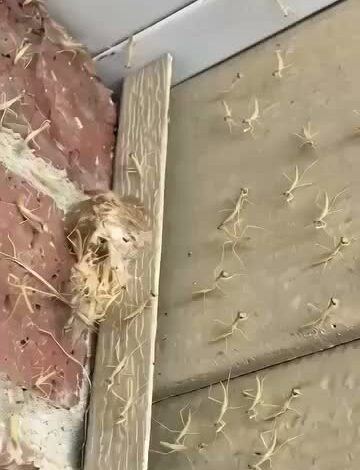
What started as an ordinary spring morning quickly turned into one of the most fascinating discoveries I’ve ever made.
I stepped outside expecting nothing more than sunshine and fresh air. Instead, I found my front doorstep covered with dozens of tiny green insects moving in every direction.
At first, I wasn’t even sure what I was looking at.
They were incredibly small—barely larger than a fingertip—and scattered across the ground, the brick wall, and the nearby plants. Some crawled carefully along cracks in the pavement. Others clung motionless to the wall as if gathering their bearings before venturing into the world.
Curious, I crouched down for a closer look.
That’s when I realized what they were.
Baby praying mantises.
Suddenly, an ordinary morning became something extraordinary.
The area around my front door seemed alive with movement. Tiny mantises climbed the bricks, explored nearby shrubs, and spread across the garden like miniature explorers beginning a remarkable journey.
As I looked around, I eventually found the source.
Attached to a corner near the doorway was a small tan structure that looked almost like dried foam.
It was an ootheca—a protective egg case created by a female praying mantis.
Months earlier, without me ever noticing, a mother mantis had carefully deposited dozens of eggs inside this natural nursery. She then covered them with a foamy substance that hardened into a durable shell, protecting the developing insects from winter weather, predators, and harsh environmental conditions.
For months, the eggs remained hidden in plain sight.
Then spring arrived.
As temperatures warmed, the case opened and dozens of tiny mantises emerged almost at once.
What amazed me most was how close this had been to my daily life.
I had walked through that doorway countless times without noticing the egg case. Nature had been quietly preparing this incredible event just inches from where I lived.
The newly hatched mantises, known as nymphs, looked like miniature versions of their adult counterparts.
Unlike butterflies and other insects that undergo dramatic metamorphosis, praying mantises develop gradually. They don’t form cocoons or emerge transformed. Instead, they grow through a series of molts, shedding their exoskeleton multiple times as they mature.
Even at this tiny size, they already possessed the features that make mantises so recognizable.
Their triangular heads.
Their large watchful eyes.
Their folded front legs that resemble hands held in prayer.
Everything was already there, perfectly formed on a smaller scale.
Watching them spread out across the yard was surprisingly captivating.
Some climbed toward sunlight.
Others disappeared into nearby flowers and bushes.
A few stopped frequently, almost as if they were carefully studying their surroundings before moving again.
Their future, however, would not be easy.
Young mantises face countless dangers from birds, spiders, ants, and other predators. Even fellow mantises can become threats when food becomes scarce.
Only a small percentage survive long enough to reach adulthood.
That reality made the moment feel even more meaningful.
Every tiny mantis represented possibility.
Every one was beginning a journey that would test its ability to survive.
Praying mantises are among nature’s most efficient hunters. Their front legs are equipped with sharp spines designed to capture prey with incredible speed and precision.
Their eyesight is equally remarkable.
Large compound eyes provide an expansive field of vision, while their flexible necks allow them to rotate their heads and monitor their surroundings with impressive accuracy.
Even these newborn nymphs displayed the same extraordinary design.
They looked like miniature predators preparing for life in the natural world.
Despite their fierce reputation among insects, mantises play an important role in maintaining ecological balance.
They feed on flies, mosquitoes, aphids, caterpillars, beetles, moths, and many other insects.
For gardeners, they are often welcome visitors because they naturally help control pest populations without relying on chemical pesticides.
Their presence supports healthy ecosystems and contributes to a natural balance between predators and prey.
As I watched dozens of hatchlings moving through my yard, I couldn’t help imagining them returning later in the summer as fully grown adults, quietly patrolling flowers and garden beds.
Experts generally recommend leaving mantis hatchlings undisturbed if you encounter them.
At this stage, they are extremely fragile.
The best thing you can do is simply observe, avoid pesticides, and provide a healthy natural environment where they can thrive.
Over the coming months, the survivors will molt repeatedly, growing larger with each stage of development.
By late summer, many will have developed wings and reached adulthood, continuing a life cycle that has existed for millions of years.
What stayed with me most wasn’t the rarity of the sight.
It was the lesson hidden within it.
There was no dramatic announcement.
No grand spectacle.
Just dozens of tiny lives quietly beginning their journey.
It reminded me how much of nature unfolds unnoticed around us.
While we focus on schedules, responsibilities, and daily routines, countless stories of growth, survival, and renewal are taking place all around us.
The mantises had been developing beside my front door for months without my awareness.
Yet their emergence transformed an ordinary day into an unforgettable memory.
Throughout history, praying mantises have often been associated with patience, awareness, and careful observation.
Watching these tiny hatchlings seemed to reflect those qualities perfectly.
They didn’t rush.
They paused.
Observed.
Adjusted.
Then continued moving forward.
There was something surprisingly inspiring about that.
As the morning passed and the sun climbed higher, the scene slowly began to change.
One by one, the tiny mantises disappeared into the surrounding vegetation.
Within an hour, most were gone.
The doorstep looked completely ordinary again.
Anyone arriving later would never have known what had happened there.
But I knew.
And I carried that memory with me.
Because sometimes the most remarkable moments aren’t found in distant places or extraordinary adventures.
Sometimes they happen right outside your own front door.
All it takes is slowing down long enough to notice.
And when you do, even the smallest creatures can offer powerful reminders about patience, resilience, growth, and the endless cycle of life unfolding around us every day.