Lip reader reveals what FIFA president whispered to Trump as he refused to leave Spain’s World Cup photo

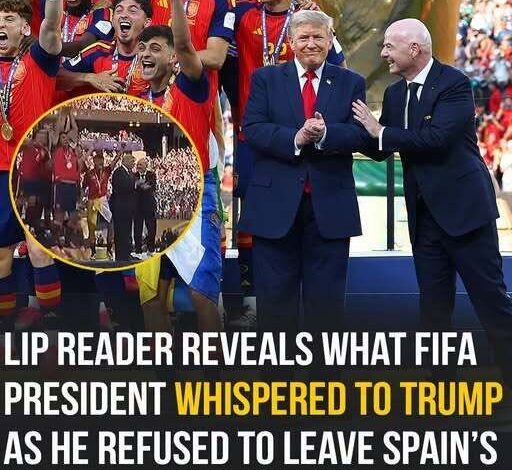
Spain had finally reached the pinnacle of world football. Fireworks illuminated the sky, confetti drifted across the stadium, and players embraced one another with tears of joy after achieving the greatest prize the sport has to offer. It was the kind of celebration every footballer dreams about—a moment destined to be remembered for generations.
Yet as the champions prepared for the iconic trophy photograph, an unexpected moment on the presentation stage quickly became the focus of worldwide attention.
During the World Cup trophy ceremony, television cameras captured U.S. President Donald Trump remaining near the center of the stage as Spain’s players gathered around the trophy. At the same time, FIFA President Gianni Infantino appeared to exchange a few words while officials worked to organize the traditional team photo.
The interaction lasted only a few seconds.
That was all it took for the footage to spread across social media.
Within minutes, millions of viewers were replaying the clip, slowing it down frame by frame and debating exactly what had happened. Some believed Infantino was encouraging Trump to move aside so the newly crowned champions could have the stage to themselves for the official photograph. Others argued it looked like nothing more than routine coordination during a busy medal ceremony, where players, dignitaries, photographers, security personnel, and officials are all moving at once.
The discussion intensified after reports surfaced claiming that a professional lip reader interpreted Infantino’s remarks as, “This is for them. We’ve given them the trophy, let’s go.” Lip-reading interpretations cannot be independently confirmed and should be viewed with caution, but the reported quote spread rapidly online, becoming part of the growing conversation.
Whether those were the exact words or not, the images themselves sparked intense debate.
Many fans felt the spotlight should have remained entirely on Spain’s players, who had earned the biggest achievement in international football. Others pointed out that political leaders and dignitaries have long appeared during major sporting ceremonies, arguing that the exchange was being blown far out of proportion.
As the debate continued, another detail attracted attention.
Some of FIFA’s officially distributed celebration photographs appeared different from images circulating across social media. In several official photos, Trump was absent from the final composition, leading some online users to speculate that the selected images were intended to keep the focus squarely on Spain’s players and coaching staff rather than the dignitaries present during the presentation.
For many supporters, that seemed entirely appropriate.
The defining photograph of a World Cup victory, they argued, should belong to the athletes whose years of dedication and sacrifice culminated in lifting football’s most prestigious trophy.
Online reaction quickly split into familiar camps.
Memes appeared almost immediately. Users shared edited videos, humorous comparisons, and countless opinions about what had unfolded on the crowded stage. Some criticized what they viewed as an unnecessary distraction during Spain’s celebration, while others dismissed the entire controversy as another example of the internet turning an ordinary ceremonial moment into a global headline.
The conversation reflected something much larger than a single photograph.
In today’s world, major sporting events rarely end with the final whistle. Every expression, gesture, and brief interaction can become its own viral story, analyzed from every angle by millions of viewers within hours.
But while social media debated those few seconds, Spain’s players focused on celebrating the achievement they had worked so hard to earn.
Once the official ceremony concluded, attention naturally returned to the champions.
Players hugged family members, waved Spanish flags, danced across the stage, and lifted the World Cup above their heads as confetti continued to rain down. Smiles replaced exhaustion, teammates posed for endless photographs, and supporters celebrated a triumph built on talent, determination, and months of outstanding performances.
Those scenes ultimately reminded everyone why the night mattered.
The discussion surrounding the podium may dominate online conversations for a while, but history is far more likely to remember Spain’s remarkable tournament than a brief exchange during the trophy presentation.
It will remember the captain raising the World Cup.
It will remember the teammates celebrating together after reaching the summit of world football.
And it will remember the joy of a nation watching its dream become reality.
Moments of distraction are almost inevitable during events watched by billions around the globe. Cameras capture everything, and social media ensures that even the shortest interactions can become worldwide talking points.
But those moments rarely define history.
Championships do.
Years from now, fans will remember Spain’s football, the resilience that carried them through the tournament, and the unforgettable image of a team standing together as world champions. The online debates, slow-motion analyses, and arguments over podium etiquette will gradually fade.
The victory itself will endure.
Because despite the unexpected controversy and the brief shift in attention, nothing diminished what Spain accomplished on that unforgettable night. They remained exactly what they had earned the right to be—world champions.
When the confetti settled, the lights dimmed, and the celebrations came to an end, one truth remained unchanged.
Spain had conquered the world, and that achievement would always be the story that mattered most.