It catches many homeowners completely by surprise.
You plug a phone charger into an outlet, but nothing happens. Then you flip a nearby wall switch, and suddenly the outlet has power. Or maybe you notice a receptacle installed upside down, with the grounding hole positioned at the top, and wonder whether an electrician made a mistake.
In many cases, neither situation is accidental.
These details can be traced back to an older approach to home lighting, when floor and table lamps often provided most of the light in a room.
Before ceiling fixtures became common, builders frequently wired a wall switch to control an electrical outlet rather than an overhead light. The concept was simple: plug a lamp into the outlet, walk into the room, flip the switch, and the lamp would turn on without anyone having to reach for it.
It was a practical solution, and it remains common in many older houses and even some newer homes.
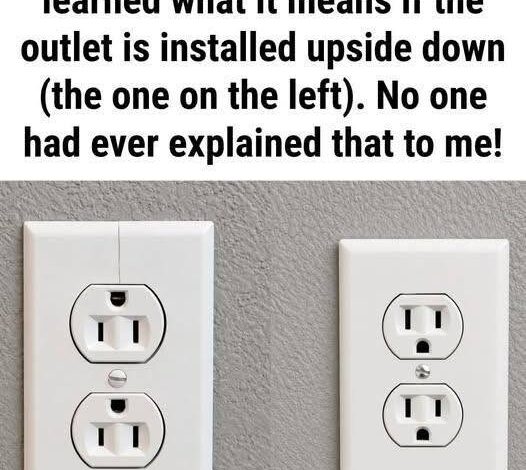
To make these outlets easier to identify, some electricians developed a simple visual convention: they installed the receptacle upside down.
Instead of placing the grounding slot at the bottom, they positioned it at the top. This could serve as a subtle indication that the outlet was connected to a wall switch.
But there’s another detail that often goes unnoticed.
A standard two-socket outlet may be wired so that only one half is controlled by a switch. One receptacle receives power only when the wall switch is turned on, while the other remains energized continuously.
This arrangement is especially useful in rooms where a lamp needs to be controlled from the doorway, while another device—such as a clock, router, charger, or other electronics—needs uninterrupted power.
It’s a simple design that provides both convenience and flexibility.
However, there is an important misconception to clear up.
An upside-down outlet does not automatically mean it is switch-controlled.
The National Electrical Code in the United States does not require standard residential receptacles to be installed in one particular orientation. Depending on local practices, electrician preference, manufacturer guidance, or the circumstances of the installation, a receptacle may be installed with the grounding slot facing up, down, or even sideways.
Some electricians choose to place the grounding slot on top for reasons unrelated to switched outlets.
For example, if a metal object were to fall between a partially unplugged cord and the receptacle, having the grounding pin positioned above the current-carrying blades could potentially reduce the chance of creating a short circuit. Other electricians simply follow company standards or match the orientation already used throughout the home.
And sometimes, there’s no special reason at all.
A previous homeowner or electrician may have installed the outlet that way simply because they preferred the appearance.
That’s why you shouldn’t rely on orientation alone.
The most reliable way to determine whether a receptacle is controlled by a wall switch is to test it.
A small table lamp is perfect for this. Plug it into the outlet, turn the lamp on, and then flip nearby wall switches one at a time. If the lamp turns off and on with one of the switches, you’ve found a switched receptacle.
If the outlet has two sockets, test both of them separately.
It’s common for one half to be switch-controlled while the other remains powered continuously. Checking each socket individually tells you exactly how the receptacle is wired.
This simple test can also solve a surprisingly common household mystery.
People sometimes assume an outlet has stopped working when the real problem is simply that the controlling wall switch is turned off. That misunderstanding can lead to frustration and even unnecessary service calls when the electrical system is functioning normally.
Once you know which outlets are connected to switches, they become much more useful.
They’re perfect for floor lamps in living rooms, bedside lamps, seasonal decorations, and other lighting that you want to control easily from the entrance to a room. At the same time, you’ll know which outlets should be used for devices that need constant electricity.
Understanding how your home’s electrical system is arranged can also make basic troubleshooting easier.
If something suddenly loses power, you’ll know whether a wall switch might be involved before assuming there’s a wiring problem or a tripped breaker.
Of course, not every electrical issue can be solved with a simple switch test.
If an outlet still doesn’t work after checking the switches—or if you notice discoloration, sparks, unusual heat, damage, or loose connections—it should be inspected by a qualified electrician. Electrical repairs can be dangerous, so anything beyond your experience level should be left to a professional.
In the end, that upside-down outlet may not be a mistake at all.
It could be a leftover from an era when a floor lamp served as the primary light source in a room and clever electrical wiring made everyday life more convenient.
Sometimes the orientation indicates a switched receptacle.
Sometimes it reflects an electrician’s preferred installation method.
And sometimes, it’s simply the result of personal preference.
The only reliable way to know is to test it.
Once you do, one of those small mysteries around your home may turn into a useful feature—and a reminder that even the simplest details of a house can have a story behind them.