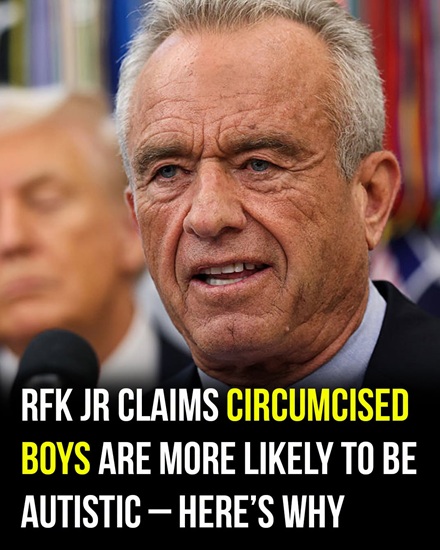
Recent remarks by Robert F. Kennedy Jr. have reignited debate across the medical and public health communities, placing him once again at the center of a controversial discussion about autism, pregnancy, and the role of scientific evidence in public policy.
During a recent meeting involving former President Donald Trump and senior administration officials, Kennedy reportedly revisited a claim that has drawn criticism from researchers and healthcare organizations for years: the possibility of a connection between acetaminophen, commonly sold under brand names such as Tylenol, and autism spectrum disorder.
Although Kennedy acknowledged that no definitive scientific proof currently exists to establish such a link, he argued that the subject warrants further investigation. His comments immediately sparked renewed controversy, reopening a debate that health experts say has already been extensively examined through decades of research.

The issue is not new. Both Kennedy and Trump have previously questioned whether certain medications taken during pregnancy could influence developmental outcomes in children. However, major medical organizations have repeatedly stated that existing evidence does not support a direct causal relationship between routine acetaminophen use during pregnancy and autism.
Researchers continue to study autism’s origins, which are widely understood to involve a complex combination of genetic, biological, and environmental factors. Despite ongoing scientific inquiry, no single cause has been identified, and experts emphasize that autism cannot be attributed to one factor alone.
Following Kennedy’s latest remarks, pharmaceutical companies and medical organizations responded swiftly. Manufacturers of acetaminophen-based products reaffirmed that the medication remains widely regarded as safe when used according to established medical guidelines. Healthcare professionals and autism advocacy groups also voiced concern, arguing that public speculation about unproven risks could create unnecessary anxiety among expectant parents.
Critics contend that statements from influential public officials carry significant weight, particularly when discussing sensitive issues involving pregnancy and child development. They warn that presenting hypothetical risks without strong supporting evidence may unintentionally undermine confidence in established medical guidance.
Kennedy, however, maintained that additional research should be encouraged, suggesting that current studies do not fully resolve all questions surrounding the issue. He also expressed caution regarding medication use during pregnancy, advocating that drugs should be used only when medically necessary.
Many healthcare experts responded by emphasizing that treatment decisions during pregnancy should be guided by evidence-based recommendations developed through extensive clinical research. They argue that discouraging approved medical treatments without compelling scientific support risks creating confusion rather than clarity.
The controversy intensified further when Kennedy made an inaccurate anatomical reference while discussing fetal development. The comment was quickly challenged by medical professionals, who noted that fetal development occurs within the uterus, not the placenta. The mistake circulated widely online and became a focal point for critics who argued that complex medical topics require precise and scientifically accurate communication.
Kennedy also referenced an earlier observational study that explored a statistical association between infant circumcision and autism diagnoses. Researchers connected to that study have repeatedly clarified that the findings demonstrated correlation rather than causation and did not establish a direct relationship between the two. Medical experts frequently caution that observational data alone cannot determine cause-and-effect relationships without rigorous controlled research.
Beyond the specific claims themselves, the episode has fueled a broader discussion about public trust in science and healthcare communication. Public health specialists argue that statements from prominent political figures can significantly influence public perception, particularly when addressing topics that affect parents and families.
Many experts worry that ongoing debates centered on unsupported theories may distract attention from evidence-based healthcare guidance and reinforce misunderstandings about autism. Advocacy organizations have also expressed concern that speculative discussions about causes can inadvertently contribute to stigma while shifting focus away from improving support, inclusion, and services for autistic individuals and their families.
Supporters of Kennedy counter that questioning established assumptions is a legitimate part of scientific inquiry. They argue that research should remain open to examining new possibilities, even when those questions challenge prevailing views.
Most scientists agree that continued investigation is valuable. However, they emphasize that meaningful conclusions must be based on rigorous methodology, peer-reviewed evidence, and reproducible findings rather than speculation or anecdotal observations.
As debate surrounding Kennedy’s comments continues, the controversy highlights a larger challenge facing modern society: balancing open discussion with scientific responsibility. In an era where information spreads rapidly and public figures have enormous influence, experts stress the importance of distinguishing between established evidence, ongoing research, and personal opinion.
Ultimately, the discussion extends beyond one individual or one claim. It reflects broader questions about how health information is communicated, how public trust is maintained, and how scientific uncertainty should be discussed responsibly. While continued research remains an essential part of medical progress, healthcare professionals maintain that claims about potential risks should be supported by strong evidence before being presented as credible conclusions.
Without that foundation, they warn, speculation can spread faster than facts—creating confusion, fear, and mistrust among the very people seeking reliable guidance.