One tranquilizer dart.
One panicked reaction.
One massive black bear drifting toward disaster in open water.
What began as a routine wildlife operation along Florida’s Gulf Coast quickly turned into a rescue that would leave witnesses stunned and become one of the most remarkable animal-saving stories in the state’s history.
In 2008, residents near Alligator Point spotted an unexpected visitor wandering dangerously close to homes.
It wasn’t a small animal.
It wasn’t a brief sighting.
It was a fully grown black bear weighing nearly 400 pounds.
The massive animal had wandered into a residential area, immediately raising concerns among homeowners and wildlife officials alike.
Phone calls flooded local authorities.
Residents worried about their families.
Wildlife officers worried about the bear.
The Florida Fish and Wildlife Conservation Commission responded quickly.
Their objective was simple: safely capture the bear, relocate it away from populated areas, and prevent a potentially dangerous encounter.
At first, everything appeared routine.
Experienced wildlife officers assessed the situation and chose a standard solution—a tranquilizer dart.
The method had been used successfully countless times before.
The plan was straightforward.
Sedate the bear.
Transport it safely.
Release it into a more suitable habitat.
The dart hit its target.
For a brief moment, everything seemed to be going according to plan.
Then the situation changed instantly.
Startled by the impact, the bear exploded into motion.
Instead of slowing down, it bolted.
Witnesses watched in disbelief as the enormous animal sprinted away from officers and headed straight toward the shoreline.
Within seconds, it plunged into the Gulf waters.
What had been a controlled wildlife operation suddenly became an emergency.
At first, the bear swam strongly.
Powerfully.
Confidently.
But the tranquilizer was already beginning to take effect.
Its movements gradually became less coordinated.
Its strokes weakened.
Its head dipped lower.
Those watching from shore immediately understood the danger.
A sedated bear cannot swim for long.
And this bear was rapidly losing the ability to stay afloat.
What had started as a relocation effort had transformed into a race against time.
Standing nearby was Florida Fish and Wildlife biologist Adam Warwick.
He saw what everyone else saw.
The bear was struggling.
The medication was working.
And if nobody acted immediately, the animal was going to drown.
There wasn’t time for lengthy discussions.
No opportunity to create a detailed rescue plan.
Only seconds to make a decision.
Years later, Warwick would describe his choice as instinctive.
He didn’t stop to calculate risks.
He didn’t think about recognition.
He simply recognized a life in danger.
Then he moved.
Without hesitation, Warwick entered the water.
The risks were enormous.
This wasn’t a domesticated animal.
It wasn’t even a small wild animal.
It was a 400-pound black bear under the unpredictable effects of sedation.
At any moment, panic could take over.
The animal could lash out.
It could regain enough strength to become extremely dangerous.
Most people would have stayed safely on shore.
Warwick didn’t.
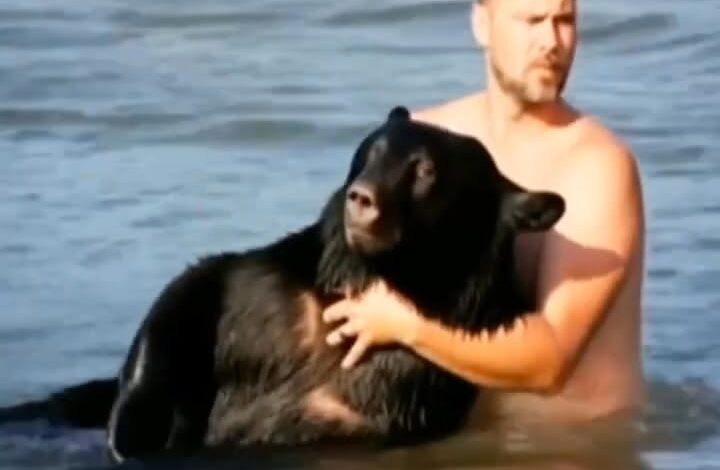
Driven by training, responsibility, and pure adrenaline, he swam toward the struggling bear.
The scene was extraordinary.
The bear, exhausted and disoriented, seemed to recognize that the man approaching wasn’t a threat.
Instead of reacting aggressively, it allowed Warwick to come alongside.
Even then, the challenge was immense.
The animal was rapidly losing strength.
Its head repeatedly slipped closer to the water.
Each wave threatened to push it under.
Warwick positioned himself beside the bear and began guiding it toward shore.
Slowly.
Carefully.
One yard at a time.
The effort was exhausting.
The bear drifted lower.
Warwick adjusted.
The bear struggled.
Warwick kept moving.
Again and again.
For what felt like an eternity, the biologist fought both the water and the clock.
Those watching from land could do little more than hope.
The margin for error was almost nonexistent.
One mistake.
One unexpected movement.
One moment of panic.
Any of them could have ended the rescue—or worse.
But little by little, progress was made.
The shoreline grew closer.
The water became shallower.
And finally, the exhausted bear regained its footing.
The massive animal stumbled onto solid ground.
Moments later, Warwick did the same.
Against incredible odds, both had made it safely back.
Remarkably, despite the danger and physical struggle, Warwick escaped with nothing more than a minor scratch.
The crisis, however, wasn’t over yet.
The bear still needed to be transported before the sedative wore off completely.
Additional wildlife officers quickly stepped in.
Working together, they carefully secured the exhausted animal using available equipment, including a tractor fitted with a front-end bucket.
Every movement required patience.
After coming so close to losing the bear, nobody wanted to risk injuring it during the final stage of the operation.
Eventually, the bear was safely loaded for transport.
Its destination was Osceola National Forest—a vast protected wilderness offering everything it needed to survive far away from residential neighborhoods.
Food.
Water.
Shelter.
Space.
Warwick accompanied the relocation effort, helping ensure the animal remained stable throughout the journey.
By the time the bear was released into its new home, the dramatic rescue had already become legendary among wildlife officers across Florida.
What could have ended as a tragedy had become a remarkable success story.
The incident also highlighted a growing challenge faced across North America.
As human development expands into natural habitats, encounters between people and wildlife become increasingly common.
Bears searching for food may wander into neighborhoods.
Residents may unknowingly attract animals through unsecured garbage, pet food, or other sources.
Each encounter creates risks for both humans and wildlife.
That’s why professionals like Warwick play such an important role.
Their work extends far beyond relocating animals.
They must make difficult decisions under pressure.
Assess unpredictable situations.
Balance public safety with animal welfare.
And sometimes, they must accept significant personal risk.
Warwick has always downplayed his actions.
Rather than focusing on heroics, he has emphasized the teamwork involved and the larger mission of wildlife conservation.
But those who witnessed the rescue know just how extraordinary his response truly was.
Most people never face a moment where they must choose between personal safety and saving the life of a struggling wild animal.
Warwick faced that choice.
And when the moment came, he acted.
The rescued bear’s story became more than a tale of survival.
It became a reminder of what conservation looks like in the real world.
It isn’t always found in research papers or policy discussions.
Sometimes conservation happens in the middle of a crisis.
Sometimes it requires quick thinking, courage, and a willingness to step into danger when every second counts.
Today, the bear is long gone from public attention, living the life nature intended.
But the story remains.
A powerful reminder that preparation matters.
Experience matters.
Compassion matters.
And sometimes, one person’s decision to act can mean the difference between life and death.
On that day near Alligator Point, a frightened bear entered the water facing almost certain disaster.
Because one wildlife biologist refused to stand by and watch, it was given something priceless.
A second chance at life.