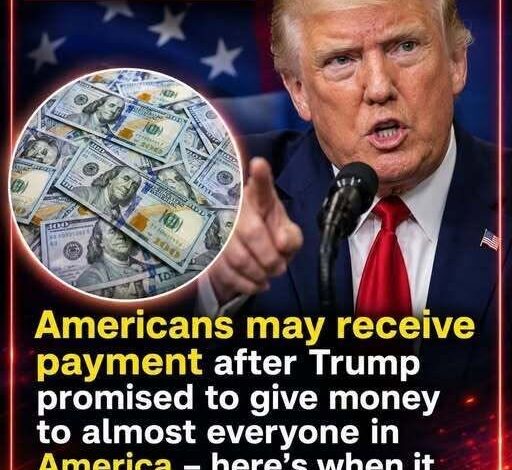
A viral social media claim suggesting that Americans could soon receive cash payments following comments by President Donald Trump has generated widespread attention and debate online. The posts, often presented in a breaking-news format, imply that money may soon be deposited into the bank accounts of millions of Americans. While the proposal has been publicly discussed, no nationwide payment program has been officially approved or finalized.
The idea centers on what Trump has described as a potential “tariff dividend” — a plan that would use revenue generated from tariffs on imported goods to provide direct payments to many Americans. Under the concept, high-income earners could be excluded, while eligible households might receive payments of at least $2,000. Trump has argued that if tariffs generate substantial revenue, a portion of those funds should be returned to American citizens rather than remaining entirely within government accounts.
The proposal immediately attracted attention because it resembles previous stimulus-style payments that provided financial assistance to households during periods of economic uncertainty. Supporters argue that such payments could help families facing higher living costs, inflation, and ongoing financial pressures.
However, economists, policy analysts, and financial experts have cautioned against assuming that any payment is guaranteed.
While the idea has been publicly promoted, significant questions remain about how such a program would work in practice. Before any payments could be distributed, lawmakers would likely need to establish eligibility requirements, determine funding mechanisms, define income limits, and decide how the money would be delivered. Additional questions would include whether payments would be issued through direct deposits, tax credits, rebate programs, or another method entirely.
Funding remains one of the largest challenges.
Experts note that sending $2,000 payments to a broad segment of the American population could require hundreds of billions of dollars. Critics of the proposal question whether tariff revenue alone could generate enough money to support a program of that size while also funding other government obligations. Several economic analysts have pointed out that the long-term financial calculations behind the proposal remain uncertain.
There are also legal and political considerations.
Revenue collected through tariffs is deposited into the U.S. Treasury, and any large-scale distribution of funds would likely require congressional approval. A president cannot simply redirect federal revenue into personal payments without following established legislative processes. Additionally, some tariff-related policies connected to the proposal have faced legal challenges, which could further affect the availability of funds and the feasibility of implementing such a program.
For now, financial experts advise Americans to approach viral claims with caution.
There is currently no confirmed payment date, no finalized eligibility list, and no official application process. Any legitimate federal payment program would be announced through official government agencies, such as the Treasury Department or the IRS, rather than through social media graphics, online advertisements, or unofficial websites.
Consumers are also being warned to remain vigilant against scams.
Whenever discussions of government payments gain public attention, fraudulent websites and misleading posts often appear, encouraging people to click links, provide personal information, or attempt to “claim” funds that do not actually exist. Officials consistently recommend relying on verified government sources for accurate information.
Despite the uncertainty, the proposal has captured public interest because it touches on several issues that remain central to national debate, including inflation, trade policy, household finances, government spending, and economic relief.
Many Americans continue to watch closely for any developments that could impact their financial situation, making the idea of a tariff-funded payment particularly appealing to some households.
At this stage, however, the proposal remains exactly that—a proposal.
While Trump has publicly discussed the possibility of using tariff revenue to provide payments to Americans, no nationwide program has been formally approved, funded, or scheduled for distribution.
Until official legislation or government guidance is released, the most accurate conclusion is straightforward: the idea exists, the discussion is ongoing, but no guaranteed payment is currently on the way.
If the proposal advances in the future, the most important details to monitor will be eligibility requirements, income thresholds, funding approval, payment amounts, and the official timeline for distribution.
Until then, viral headlines may generate excitement, but Americans should avoid assuming that any payment is certain until it is formally authorized through official channels.