If someone showed you this image for just a few seconds, there’s a good chance you would believe it was real.
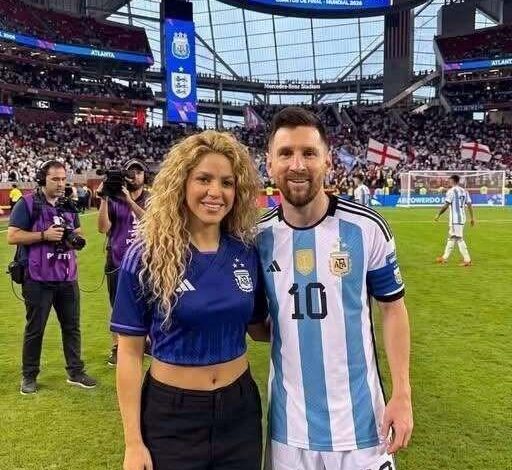
A packed football stadium. Thousands of fans waving national flags. Bright floodlights reflecting across the pitch. A World Cup scoreboard in the background. And standing in the middle of it all appears to be global superstar Shakira, seemingly part of another unforgettable football celebration.
It certainly looks like a photograph taken during one of the biggest sporting events in the world.
Except it isn’t.
No photographer captured this moment.
No television broadcast ever showed it.
No World Cup match produced this scene.
The entire image was created by artificial intelligence.
That is exactly why pictures like this deserve a closer look.
Only a few years ago, AI-generated images were easy to recognize. Faces looked unnatural, backgrounds appeared distorted, and objects often blended together in impossible ways. Today, however, the technology has advanced dramatically. Modern AI systems can recreate lighting, reflections, stadium architecture, and even crowd behavior with remarkable realism, making fictional scenes appear almost identical to genuine photographs.
Instead of creating something obviously fake, artificial intelligence now creates something that feels familiar.
And familiarity builds trust.
Every detail in this image has been carefully designed to trigger that response. The stadium resembles venues millions of football fans have seen before. The scoreboard includes recognizable tournament branding. The floodlights cast realistic reflections, while the colors and atmosphere closely resemble a live World Cup broadcast.
At first glance, nothing seems unusual.
But first impressions aren’t always accurate.
The longer you study the image, the more subtle imperfections begin to appear.
Lighting may strike people from angles that don’t quite make sense. Shadows sometimes disappear or point in conflicting directions. Faces in the crowd can become repetitive or strangely blurred. Hands and fingers occasionally appear misshapen, while clothing folds blend together in ways that real cameras rarely capture.
Then there’s the text.
Artificial intelligence still struggles with written language. Signs, scoreboards, and advertisements often contain unusual spellings, mixed languages, or letters that look almost correct—but not quite. Those tiny mistakes frequently become some of the strongest clues that an image was generated rather than photographed.
The challenge is that most people never look that closely.
Social media moves too fast.
Users often spend only a few seconds deciding whether something is worth sharing. If a picture creates surprise, excitement, or curiosity, many people repost it long before asking where it came from or whether it actually represents a real event.
That’s one reason AI-generated content spreads so quickly.
People don’t necessarily share what they know is true.
They share what feels believable.
Creators of synthetic media understand this psychology extremely well. Instead of inventing completely unrealistic scenarios, they combine people, places, and events that audiences already recognize. The result is content that sits comfortably between reality and fiction, making it much harder for viewers to question what they’re seeing.
This image follows exactly that formula.
Football is watched by billions around the world.
Shakira has been closely associated with the sport through memorable performances at major international tournaments.
Putting those familiar elements together inside a convincing World Cup setting creates a scene that seems entirely possible—even though it never existed.
That is the real power of artificial intelligence.
It doesn’t need to create something impossible.
It only needs to create something believable.
As AI technology continues to improve, this challenge will only become more significant. Images are becoming harder to distinguish from authentic photographs, while realistic videos, voices, and digital recreations are advancing at an equally rapid pace.
The consequences extend far beyond entertainment.
A fabricated celebrity appearance can spread across the internet within minutes.
A fake political photograph can influence public discussion before fact-checkers have time to respond.
An invented disaster scene can create confusion and unnecessary panic long before the truth catches up.
Even harmless AI creations contribute to a world where visual evidence is no longer automatically trusted.
Ironically, as artificial images become more realistic, genuine photographs often face greater skepticism as well.
That doesn’t mean AI is inherently negative.
Used responsibly, it can produce remarkable artwork, educational illustrations, visual effects, and creative storytelling. Problems arise only when fictional content is presented as genuine or shared without making its artificial origin clear.
The responsibility ultimately belongs to everyone.
Before believing a dramatic image, it’s worth taking a moment to ask a few simple questions. Has a reputable news organization reported the event? Does the source appear trustworthy? Are there visual details that seem inconsistent? Could the image have been generated rather than captured?
A few seconds of careful observation can often reveal what thousands of instant shares overlook.
Perhaps that’s the most important lesson images like this teach us.
Artificial intelligence has reached the point where creating convincing illusions is no longer the difficult part.
Recognizing those illusions has become the real challenge.
In a digital world where technology can generate events that never happened and memories that never existed, our ability to think critically has become just as important as our ability to see.
Because sometimes, the most convincing photograph you’ll encounter isn’t documenting reality at all.
It’s documenting just how easily reality itself can be imitated.