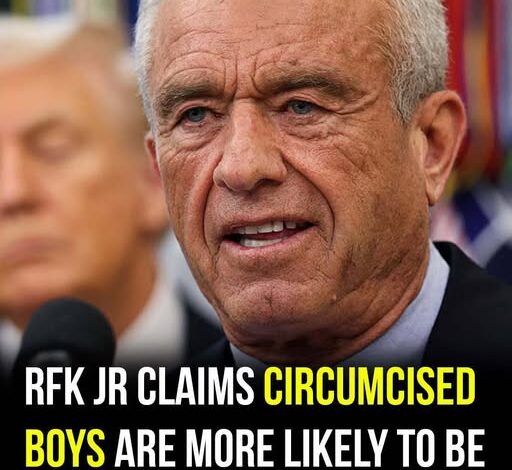
The controversy surrounding Robert F. Kennedy Jr.’s remarks reaches far beyond a single meeting or political exchange. At its core lies a challenge that public health experts, researchers, and policymakers have wrestled with for decades: how to discuss scientific uncertainty responsibly without creating unnecessary fear or confusion.
Science advances through questions. Researchers investigate possibilities, test theories, challenge assumptions, and continuously refine understanding as new evidence emerges. This process is essential to scientific progress. However, experts emphasize that there is an important distinction between exploring a hypothesis and presenting an unproven idea in a way that may be interpreted as established fact.
In discussions surrounding autism, scientists have spent decades examining a wide range of potential influences, including genetics, prenatal development, environmental exposures, and other biological factors. While research continues to evolve, major health organizations and extensive scientific reviews have not established a direct causal relationship between routine Tylenol use during pregnancy and autism.
For many researchers, that distinction is critical.
When public figures raise possible connections that have not been supported by strong evidence, audiences may interpret speculation as certainty. In a world already saturated with conflicting information, even a brief comment can generate significant concern among families seeking guidance.
Expectant parents often face difficult decisions about health and medical care. A suggestion that a commonly used medication might pose serious risks can create anxiety, second-guessing, and fear, even when the underlying evidence remains inconclusive. In situations where clear answers do not yet exist, uncertainty itself can become a source of distress.
Many scientists who criticized the remarks say their concern extends beyond any single statement. They worry about the broader impact on public trust in health information. Effective public health guidance depends on confidence that recommendations are grounded in evidence rather than politics, ideology, or personal opinion. When that confidence weakens, confusion can spread quickly, making it harder for individuals to make informed decisions.
The discussion has also highlighted another important issue: how society talks about autism.
Many autism advocates argue that public conversations focused primarily on causes and prevention can unintentionally overlook the experiences and contributions of autistic individuals themselves. For many people, autism is not simply a medical topic—it is part of their identity, community, and lived experience. They caution that discussions framed around fear or speculation can sometimes reinforce stigma rather than understanding.
At the same time, supporters of Kennedy contend that scientific inquiry should remain open and that asking difficult questions should not automatically be dismissed. They argue that progress often begins with challenging assumptions and exploring ideas that may initially be unpopular or controversial.
Critics respond that inquiry and skepticism are valuable only when accompanied by rigorous evidence and careful communication. They emphasize that questions are essential to science, but conclusions must be supported by reliable data before being presented as credible explanations.
The disagreement reflects a broader challenge that extends far beyond this particular issue. In an era of intense political polarization and rapidly spreading information, many people struggle to determine whom they should trust. Government agencies, academic researchers, elected officials, medical professionals, independent experts, and social media personalities all compete for public attention, often offering conflicting perspectives.
As a result, even scientific and medical issues can become entangled in political debates. What one group views as healthy skepticism, another may see as misinformation. The growing divide has made it increasingly difficult to build consensus around complex health questions.
For healthcare professionals, the implications are significant. Public health efforts depend heavily on trust. Whether the issue involves vaccines, disease prevention, maternal health, or medical treatment, patients must be able to rely on evidence-based guidance. When uncertainty is amplified or misinformation spreads, healthcare providers often find themselves spending valuable time correcting misconceptions and addressing fears that may not be supported by the available evidence.
In response to the controversy, many researchers have reiterated a fundamental principle of science: questions deserve investigation, but claims require proof. Until compelling evidence exists, possibilities should not be confused with established conclusions.
That principle is not political.
It is one of the foundations of modern scientific inquiry.
As debates continue, millions of people are left navigating an environment where information travels faster than verification and where influential voices can significantly shape public perception. The challenge is not simply deciding whom to believe. It is maintaining a culture in which evidence remains the standard by which claims are evaluated and public trust is built through facts rather than fear.
Because when discussions about health become driven by speculation rather than evidence, the consequences extend far beyond politics. They affect families making medical decisions, healthcare providers offering guidance, and communities trying to navigate an increasingly complex information landscape.
Ultimately, the stakes are not merely about winning an argument. They are about ensuring that public understanding remains rooted in reliable evidence, responsible communication, and a commitment to truth.