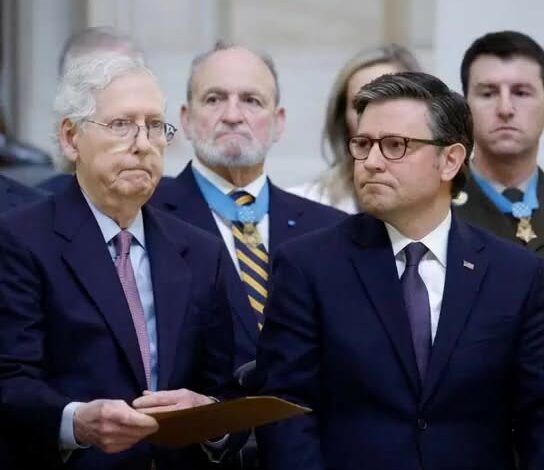
As tensions with Iran intensify, many Republican leaders have sought to present President Trump’s military campaign not merely as a strategic necessity, but as a moral obligation.
Supporters of the operation argue that Tehran has spent decades supporting regional instability, proxy conflicts, and threats against American interests and allies. From this perspective, military pressure is portrayed as a reluctant but necessary response to a dangerous adversary. Senate leaders and conservative allies have framed the campaign as an effort to prevent greater violence, protect civilians, and reduce the long-term threat posed by Iran’s military ambitions.
In their view, the use of force is not an act of aggression but an attempt to prevent even larger conflicts from emerging in the future. Some have drawn upon traditional concepts of just war theory, arguing that military action can, under certain circumstances, serve the cause of peace by deterring greater bloodshed and protecting innocent lives.
Yet not everyone accepts that argument.
A growing number of religious voices have challenged the moral foundations being used to justify the conflict. Among them is Pope Leo XIV, whose recent remarks have injected a spiritual dimension into an already volatile geopolitical debate.
By warning that Christ does not stand with those who pursue war, the pope offered a starkly different interpretation of faith’s role during times of conflict. His comments appeared to reject the idea that military action can easily be reconciled with Christian teachings, emphasizing instead the moral dangers that accompany violence and escalation.
The contrast could hardly be sharper.
On one side are political leaders who believe force may be necessary to prevent greater suffering. On the other are religious figures who argue that war itself represents a failure of humanity’s commitment to peace and reconciliation.
As military operations continue and diplomatic tensions deepen, that divide has become increasingly visible.
President Trump’s criticism of opponents, combined with expanded military measures in the region, has only intensified the debate. What began as a dispute over security policy is increasingly evolving into a broader argument about ethics, faith, and the responsibilities of leadership during times of crisis.
At its core lies a question that has accompanied nearly every major conflict throughout history:
Can military force ever serve the cause of peace, or does the pursuit of peace require rejecting violence altogether?
For supporters of the campaign, the answer is clear. They view strength and deterrence as necessary tools for preventing future conflict.
For critics, including many religious leaders, the answer is equally clear. They believe that peace built through military power carries moral costs that cannot be ignored.
As the confrontation unfolds, the debate extends far beyond battlefields, sanctions, or diplomatic negotiations. It has become a struggle over values, principles, and competing visions of what justice demands in an increasingly dangerous world.
Whether faith should justify military action or challenge it remains a question with no easy answer. But as political leaders and religious voices continue to clash over the meaning of justice, peace, and responsibility, the conflict is no longer being fought solely through policy and power.
It is also being fought through competing moral visions of what it means to do what is right.