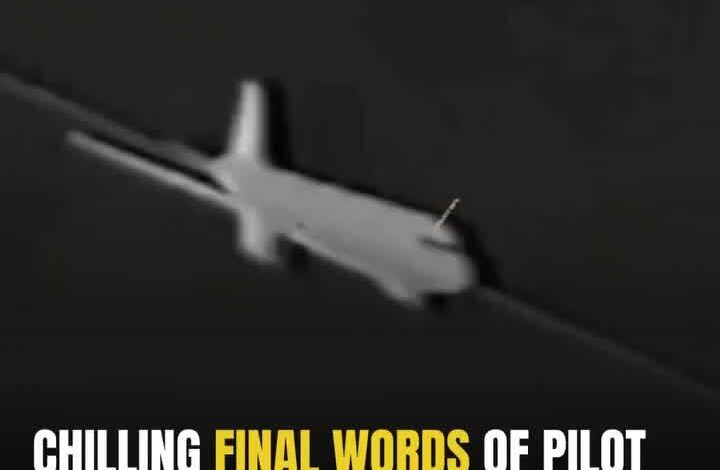
For most of the flight, everything seemed perfectly normal.
Passengers settled into their seats, watched movies, read books, or slept as the Airbus A310 cruised through the darkness above Siberia. The journey from Moscow to Hong Kong was expected to be routine—just another overnight international flight carrying travelers toward their destinations.
At 33,000 feet, there was little reason for concern.
The aircraft was operating normally.
The weather was calm.
The crew was experienced.
No one on board could have imagined that a series of seemingly harmless decisions inside the cockpit would soon trigger one of aviation’s most tragic accidents.
On March 23, 1994, Aeroflot Flight 593 departed Moscow’s Sheremetyevo International Airport bound for Hong Kong’s Kai Tak Airport.
The aircraft assigned to the route was an Airbus A310-304, a modern wide-body jet equipped with advanced automated flight systems designed to assist pilots during long-haul operations.
The cockpit crew consisted of experienced aviators, including Relief Captain Yaroslav Kudrinsky, Captain Andrey Danilov, and First Officer Igor Piskaryov.
As the aircraft cruised high above central Russia, everything appeared routine.
Then, during the quietest phase of the flight, an unusual situation began to unfold.
Captain Kudrinsky was traveling with his family.
His children, 13-year-old Yana and 15-year-old Eldar, were making their first trip abroad.
Wanting to give them a memorable experience, he invited them into the cockpit.
Although airline regulations prohibited unauthorized individuals from occupying the flight deck during flight, the atmosphere inside the cockpit was relaxed. The aircraft was cruising steadily under autopilot, and the crew apparently believed there was little risk.
Yana sat in the captain’s seat first.
To make the experience more exciting, her father adjusted the aircraft’s heading slightly, creating the impression that she was helping fly the airplane.
In reality, the autopilot remained fully engaged.
Nothing unusual happened.
After a few minutes, Yana stepped aside and her older brother took the seat.
Unlike his sister, Eldar placed pressure on the control column.
At first, the action seemed harmless.
The aircraft continued flying normally.
The crew remained relaxed.
No alarms sounded.
Nothing appeared wrong.
Yet a dangerous chain of events had already begun.
The Airbus A310’s automation system allowed pilots to override certain autopilot functions by applying sustained force to the controls.
As Eldar continued pressing against the control column, the flight computer interpreted the input as a legitimate command.
Gradually, part of the autopilot system disengaged.
The aircraft entered a partial-autopilot state.
Some automated systems remained active.
Others did not.
Control of the aircraft’s roll axis—the system responsible for banking and turning—had quietly transferred away from the autopilot.
A warning indicator appeared on the instrument panel.
The problem was simple.
Nobody noticed it.
Unlike many Soviet-designed aircraft that the crew had previously flown, the Airbus relied heavily on visual indications rather than loud audible warnings for certain automation changes.
The warning existed.
But it attracted no attention.
Meanwhile, the aircraft slowly began banking to the right.
At first, the movement was almost imperceptible.
Passengers likely felt nothing unusual.
The conversation inside the cockpit continued.
But the bank angle kept increasing.
Ten degrees.
Twenty degrees.
Thirty degrees.
The aircraft continued rolling.
Only when the bank became extreme did the pilots realize something was wrong.
By then, the situation had become far more serious than anyone initially understood.
As the bank angle increased, the aircraft could no longer maintain stable level flight.
The nose suddenly dropped.
Flight 593 entered a steep descent.
The relaxed atmosphere inside the cockpit vanished instantly.
The cockpit voice recorder captured the dramatic change.
What had been casual conversation became urgency and confusion.
Realizing the danger, Captain Kudrinsky immediately ordered his son away from the controls.
“Eldar, get away. Go to the back. Go to the back, Eldar!”
The pilots rushed to recover the aircraft.
The Airbus plunged through the night sky as they fought to regain control.
For a brief moment, their efforts appeared successful.
Using aggressive control inputs, they managed to pull the aircraft out of the dive.
But a new problem emerged.
The recovery was too aggressive.
The aircraft pitched sharply upward, converting speed into altitude.
As airspeed rapidly decreased, the wings approached their aerodynamic limits.
Then came another crisis.
The aircraft stalled.
A stall occurs when the airflow over the wings becomes insufficient to generate lift.
Contrary to popular belief, stalls are not caused by engines failing.
Even a fully functioning aircraft can stall if the wings exceed their critical angle of attack.
Flight 593 had now transitioned from a dive into a stall.
The aircraft once again began descending rapidly.
Altitude disappeared quickly.
The crew continued fighting desperately for control.
Several times they managed partial recoveries.
Several times they briefly stabilized the aircraft.
But each correction came with new complications.
The airplane remained unstable.
The terrain below was approaching rapidly.
Inside the passenger cabin, travelers likely had little understanding of the technical emergency unfolding in the cockpit.
Many may have only felt sudden changes in altitude, unusual movements, and increasing turbulence.
Few could have known how serious the situation had become.
Shortly before 1:00 a.m. local time, the final opportunity for recovery disappeared.
The Airbus struck terrain in the remote Kuznetsk Alatau mountain range near Mezhdurechensk in Russia’s Kemerovo region.
The impact destroyed the aircraft instantly.
All 75 people on board lost their lives.
In the aftermath, investigators faced the difficult task of determining what had happened.
Initially, some suspected mechanical failure.
After all, modern airliners are complex machines, and catastrophic accidents often involve technical malfunctions.
But the flight data recorder and cockpit voice recorder revealed a different story.
The aircraft itself had functioned exactly as designed.
No major mechanical failures were discovered.
Instead, investigators identified a chain of human factors that had combined to create the disaster.
The captain’s children had been allowed into the cockpit in violation of established procedures.
Eldar’s control inputs inadvertently disengaged part of the autopilot system.
The warning indication went unnoticed.
The increasing bank angle remained undetected for too long.
And by the time the pilots recognized the danger, recovery options were rapidly disappearing.
Investigators also noted that the crew had relatively limited experience with Western-designed Airbus automation systems compared to the Soviet aircraft they had previously operated.
Differences in cockpit design philosophy and warning systems may have contributed to the delayed recognition of the problem.
When details of the investigation became public, the aviation community was stunned.
Aeroflot initially denied reports that children had been present in the cockpit.
That position became impossible to maintain after cockpit voice recorder transcripts confirmed exactly what had occurred.
The accident quickly became a case study in aviation safety.
It demonstrated how multiple small decisions—each seemingly insignificant on its own—can combine into a catastrophic outcome.
A father wanted to share a memorable experience with his children.
A teenager applied pressure to a control column.
A warning light went unnoticed.
A few critical seconds passed.
And an ordinary flight became a tragedy.
The lessons from Flight 593 continue to influence aviation training today.
The accident reinforced the importance of cockpit discipline.
It highlighted the need for pilots to maintain constant awareness of automation systems.
It demonstrated that advanced technology cannot eliminate the need for vigilance and procedural compliance.
Modern aircraft are extraordinarily sophisticated.
Yet they still depend on human judgment.
Human attention.
And human responsibility.
In the years that followed, airlines around the world strengthened cockpit procedures and placed greater emphasis on automation management training.
Following the September 11 attacks, cockpit security measures became even stricter, with reinforced cockpit doors and heavily restricted access policies becoming standard worldwide.
Today, Aeroflot Flight 593 remains one of the most studied accidents in aviation history.
Not because of severe weather.
Not because of sabotage.
Not because of mechanical failure.
But because it showed how quickly a routine flight can unravel when safety procedures are ignored.
Its legacy endures in training programs, safety briefings, and cockpit protocols around the world.
A lasting reminder that in aviation, every rule exists for a reason.
And that sometimes the smallest decisions can have the largest consequences.