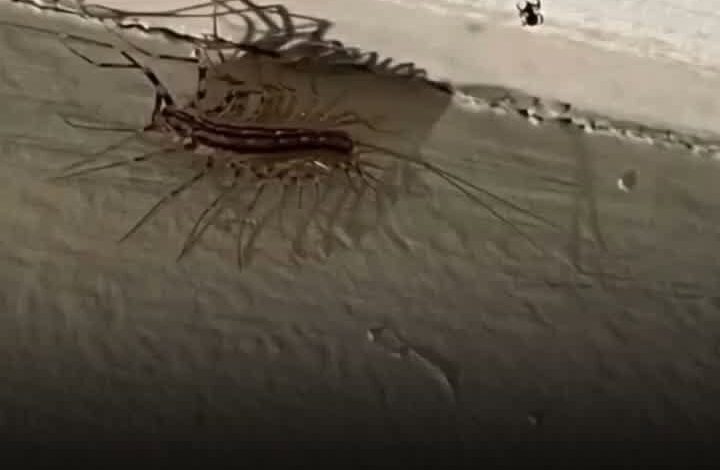
Most people have the same reaction when they spot a centipede darting across the floor.
First comes surprise.
Then discomfort.
And usually, within seconds, the search begins for the nearest shoe, tissue, or object capable of removing the unexpected visitor as quickly as possible.
With their countless legs, twitching antennae, and startling speed, centipedes have earned a reputation as one of the least welcome creatures to encounter indoors.
They seem to appear out of nowhere.
One moment the room is empty.
The next, a long-legged shadow is racing across a wall, disappearing beneath furniture, or slipping into a crack before you can react.
For many homeowners, that brief encounter is enough to trigger an immediate sense of unease.
Yet despite their appearance, centipedes are among the most misunderstood creatures commonly found in and around homes.
The reality is far less alarming than most people imagine.
In fact, these ancient predators play a surprisingly important role in controlling many of the pests homeowners dislike even more.
Centipedes belong to a group of arthropods known as Chilopoda.
Unlike millipedes, which primarily feed on decaying plant material, centipedes are active hunters.
They rely on speed, agility, and specialized venom to capture prey, making them highly effective predators both indoors and in natural environments.
Their bodies consist of multiple segments, each equipped with a single pair of legs.
Depending on the species, a centipede may have anywhere from fewer than twenty legs to well over one hundred and seventy.
Ironically, despite their name, no centipede actually possesses exactly one hundred legs.
Their long antennae serve as highly sensitive sensory tools.
Constantly moving, they help detect vibrations, chemical signals, temperature changes, and nearby movement.
These adaptations allow centipedes to navigate dark spaces and locate prey with remarkable precision.
One of the most common questions people ask is whether centipedes can bite.
Technically, they can.
Near their mouths are specialized structures called forcipules, which function like venomous claws.
Centipedes use these appendages to capture and immobilize insects, spiders, and other small animals they hunt.
Human bites, however, are uncommon.
Centipedes generally prefer to flee rather than confront anything larger than themselves.
Most bites occur only when a centipede is trapped, handled, or feels directly threatened.
Even then, the effects are usually mild.
Many people compare the sensation to a bee sting.
Temporary redness.
Minor swelling.
Localized discomfort.
Occasional itching.
Serious complications are extremely rare in healthy individuals.
The same is generally true for household pets.
While curious dogs or cats may occasionally investigate a centipede too closely, significant reactions are uncommon.
Beyond their ability to hunt, centipedes possess several remarkable traits that many people never realize.
One of the most fascinating is their ability to change throughout their lives.
As they grow, centipedes periodically shed their exoskeleton in a process known as molting.
During some molts, additional body segments and leg pairs develop.
If a leg is damaged or lost, many species can regenerate it over time.
As a result, older centipedes often possess more legs than they did when they first emerged.
Their evolutionary history is even more impressive.
Centipedes have existed on Earth for more than 400 million years.
Long before dinosaurs appeared, their ancestors were already hunting across ancient landscapes.
That extraordinary survival record has allowed them to evolve into highly specialized predators capable of thriving in a wide range of environments.
Their speed is another surprise.
Despite having so many legs, centipedes move with remarkable efficiency.
Some species can travel more than a foot per second, making them surprisingly effective hunters.
Their quick movements often make them appear even faster than they actually are, adding to the sense of alarm people feel when one suddenly races across a room.
Their appetite is equally impressive.
Smaller species feed on insects, larvae, silverfish, worms, cockroaches, and spiders.
Larger centipedes can tackle much bigger prey, including small reptiles, amphibians, and even other centipedes.
Because of this diet, they play an important role in reducing populations of nuisance pests.
Another surprising characteristic is their lifespan.
Unlike many insects that survive only a few weeks or months, centipedes can live for several years.
House centipedes, among the species most commonly encountered indoors, may survive up to six years under favorable conditions.
Some larger tropical species can live even longer.
Of course, centipedes are not only predators.
They are also prey.
Birds, frogs, toads, spiders, beetles, ants, rodents, and certain snakes all hunt centipedes as part of their natural diets.
This balance helps prevent centipede populations from becoming excessive while maintaining healthy ecosystems.
Ironically, the same creature that causes many homeowners to recoil often serves as a natural form of pest control.
House centipedes actively hunt cockroaches, termites, silverfish, spiders, ants, and other unwanted household insects.
In some cases, finding a centipede indoors may indicate the presence of an even larger population of pests hidden elsewhere in the home.
For that reason, eliminating every centipede you see is not always the most effective solution.
Unlike ants or termites, centipedes do not build colonies, create nests, or live in organized groups.
They are solitary hunters that spend most of their lives avoiding detection.
If centipedes are appearing frequently, the underlying issue is often environmental.
Moisture is one of the biggest factors attracting them.
Damp basements.
Leaky plumbing.
Poorly ventilated bathrooms.
Humid crawl spaces.
These environments support both centipedes and the insects they feed upon.
Reducing moisture levels can dramatically decrease their presence.
Repairing leaks.
Improving ventilation.
Using dehumidifiers.
Eliminating standing water.
These steps often make a home less attractive to both centipedes and their prey.
Controlling other insect populations is equally important.
When food becomes scarce, centipedes naturally move elsewhere.
Sealing cracks around windows, doors, foundations, and utility openings can also help prevent them from entering.
For recurring problems, professional pest-control services can identify and address the underlying causes.
Ultimately, centipedes are far more beneficial than their appearance suggests.
They are ancient survivors.
Efficient hunters.
Important contributors to ecological balance.
Although their sudden appearance can certainly be startling, they rarely pose a meaningful threat to people or pets.
Understanding what centipedes truly are allows fear to give way to perspective.
Rather than viewing them solely as unwanted intruders, it may be more accurate to see them as nature’s pest-control specialists—quietly working behind the scenes to keep populations of less desirable pests in check.
The next time a centipede races across your floor, it may still make you jump.
But knowing the truth behind those lightning-fast legs might make the encounter feel a little less frightening—and a lot more fascinating.