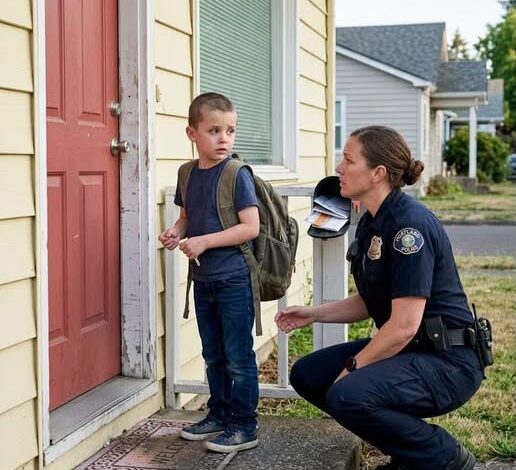
PART 1: THE KEY IN HIS BACKPACK
I couldn’t promise Jason that I controlled what every adult would decide after we walked through that door.
So I promised the only part I could control.
“I will listen to you, I will look at what you’re showing me, and I won’t pretend I didn’t see it.”
His small fingers tightened around the brass key.
“Okay,” he whispered.
The lock clicked.
I expected fear to make itself obvious the moment the door opened. Instead, the house looked painfully ordinary.
A worn brown couch sat beneath a framed family photograph. A television rested on a cheap stand. Unopened mail was stacked neatly beside a lamp. Nothing was broken. Nothing smelled dangerous. There was no dramatic scene waiting for us.
Jason shut the door carefully behind us and glanced toward the hallway.
“Dad isn’t supposed to be home yet,” he said.
I asked him to stay beside me and show me only what he wanted me to see.
He walked past the kitchen without stopping and turned down a short hallway beside the laundry area. Two bedroom doors stood open. Between them was a narrow third door painted the same pale color as the wall.
Jason pointed at it.
“That’s mine sometimes.”
I looked at him.
“Sometimes?”
“When I’m good, I sleep in my room.” He pointed toward the bedroom at the end of the hall. “When I make problems, I sleep here.”
He opened the narrow door.
Inside was a space barely wider than the washing machine. A folding table leaned against one wall. Detergent bottles were stacked above the dryer. On the floor lay a thin sleeping pad with a child-sized blanket rolled on top.
No toys.
No dresser.
No bookshelf.
Nothing that looked like a seven-year-old’s bedroom.
Then I saw the latch.
It was mounted on the hallway side of the door.
I crouched beside him.
“Does someone close this when you’re inside?”
He nodded.
“Who?”
“Dad.”
“How long do you stay in there?”
Jason stared at the floor.
“Until he says I understand.”
“Understand what?”
“That families have rules.”
My radio suddenly felt much heavier on my shoulder.
Some moments in police work aren’t loud. Sometimes the loudest thing in a room is a small piece of metal screwed into a doorframe.
Jason unzipped his backpack and pulled out a bent blue school folder.
“I tried telling another way first,” he said.
Inside was a homework assignment about home routines. On one page he had drawn his house. The front door was green. The living-room window had curtains. Across the laundry-room door he had drawn a thick black line.
Underneath, in large uneven letters, he had written:
I can’t open it when I’m learning.
Another page asked what a child should do when he felt scared.
Jason had written:
Wait until Dad is not mad.
He watched my face while I read.
“Did your teacher see this?”
“No.”
“Why not?”
“Dad checked it before I took it back.”
He swallowed.
“He said people who don’t understand families make trouble for families.”
That was the moment I understood why he hadn’t simply walked into the school office and started talking.
He didn’t think adults would ignore evidence.
He thought adults would explain it away.
PART 2: THE LATCH ON THE OUTSIDE
I radioed dispatch and requested a supervisor, keeping my voice calm and factual. A child had requested assistance, I had observed a sleeping area with an exterior latch, and the child stated he was secured inside as punishment.
Jason stared at the radio.
“Am I in trouble?”
“No.”
“Is my dad?”
“I’m not going to guess about what happens next.”
His shoulders relaxed slightly.
Less than ten minutes later, a truck pulled into the driveway.
Jason recognized it instantly. He moved behind my shoulder without being told.
A man in work clothes stepped out.
“Jason?” he called.
The boy said nothing.
The man looked at me. “I’m Mark. His father. What’s going on?”
I explained that Jason had asked me to walk him home and had shown me something inside the house.
Mark sighed sharply.
“This again.”
Jason’s fingers curled around the edge of my uniform sleeve.
Mark noticed.
“He’s seven,” he said. “He turns every consequence into a huge story.”
I asked about the narrow room beside the laundry area.
“It’s a cool-down space.”
“Does Jason sleep there?”
“If he refuses to settle down, sometimes he falls asleep there.”
“Is the door latched from the outside?”
Mark’s jaw tightened.
“It can be.”
“While he’s inside?”
“For safety.”
Jason finally spoke.
“You say it’s so I don’t ruin everyone’s night.”
Mark looked directly at him.
“Jason, stop.”
The boy shrank farther behind me.
I asked Mark not to question him while we were sorting out the situation.
Mark folded his arms.
“You’re hearing one side from a kid who gets angry when he loses privileges.”
Then he said the sentence Jason had clearly heard many times before.
“My whole family knows how we discipline children. Nobody thinks this is some crisis.”
Not denial.
Normalization.
Mark called his sister Claire, apparently expecting her to settle the matter.
“She grew up exactly like I did,” he told me. “She’ll explain it.”
Jason whispered, “She says Dad is strict because he cares.”
When Claire arrived, she looked annoyed more than worried.
“Our father was strict too,” she said. “We had consequences. Mark didn’t invent discipline.”
Jason stepped forward just enough to be seen.
“Did Grandpa lock your door?” he asked.
Claire stopped.
Mark answered quickly. “It wasn’t the same thing.”
Jason kept looking at her.
“Did he?”
A long pause.
“No,” Claire said quietly.
She walked into the hallway.
When she saw the sleeping pad, her face changed. Then she noticed the blue folder on top of the washing machine.
“Is this where he sleeps?” she asked.
“Only when he won’t settle.”
“How many nights this week?” she asked Jason.
He held up four fingers.
Mark snapped, “Because this week has been terrible.”
Claire opened the folder. The drawing with the black line across the laundry-room door lay on top.
Mark reached for it.
“That assignment caused half of this problem.”
I looked at him.
“What do you mean?”
He froze.
Too late.
“You knew he wrote this?” Claire asked.
Jason answered for him.
“He made me do another one.”
He pulled a second worksheet from his backpack.
This one was neat. The black line was gone. Under the question about feeling safe, the answer read:
I talk to my dad.
The handwriting was far more careful than the first assignment.
I asked Jason one question.
“Did you choose those answers?”
He shook his head.
Mark raised his voice.
“I helped him write something accurate instead of letting him embarrass this family.”
That sentence changed everything.
Strict parents do not need replacement homework assignments.
Children are not coached on what strangers are allowed to know unless someone already understands that the truth sounds wrong.
PART 3: WHAT THE KEY MEANT
Claire sat down slowly, still holding the two worksheets.
“You told me he was acting out for attention,” she said to her brother.
“He does.”
“You told me the room was somewhere he chose when he got overwhelmed.”
“It started that way.”
Jason spoke softly.
“No, it didn’t.”
Mark turned toward him, but I stepped between them.
“You’re letting a seven-year-old run the house,” Mark said.
“No,” I replied. “I’m making sure he can answer questions without being pressured.”
I asked Jason whether he wanted to sit outside.
He looked at me before answering.
“Can I?”
That tiny question hurt more than anything else in the house.
A child asking permission to leave a hallway in his own home.
Outside, he sat on the porch step with his backpack between his sneakers. Claire sat beside him but didn’t touch him until he leaned against her first.
That evening, after interviews, phone calls, and far too much waiting for a seven-year-old, Jason left with Claire under a temporary safety arrangement.
He carried his backpack himself.
At the curb, he stopped and pulled the old brass key from the front pocket.
“Do I still need this?”
“For now,” I told him. “Keep it with your things.”
He frowned at the key.
“I thought having a key meant I was allowed home.”
Claire looked away.
In the weeks that followed, Evergreen Elementary changed the pickup plan. Claire began bringing Jason to school each morning. Some days his hair was still damp from breakfast. Some days he forgot part of his lunch.
Those ordinary childhood mistakes felt like signs of safety.
Mark continued insisting at first that the situation had been misunderstood. But the second worksheet was difficult to explain, and Claire eventually admitted something important: their father had been strict, yes, but he had never locked a child behind a laundry-room door.
For years she had repeated the family phrase—this is just how we were raised—without examining what it was excusing.
Months later, I saw Jason outside school again. He was arguing with another child about whether a basketball shot counted.
A normal seven-year-old argument.
When he noticed me, he smiled and ran over.
He unzipped his backpack and held up a new key.
“Aunt Claire gave me this.”
“What does it open?”
“Her house.”
Then he corrected himself.
“Our house. For now.”
Later, Claire told me about the first time he used it by himself. He ran ahead, unlocked the front door, dropped his backpack beside a kitchen chair, opened the refrigerator, and called out:
“Do I have to ask before I get a snack?”
Claire told him no.
He grabbed an apple, left the refrigerator door open too long, and had to be reminded to close it.
For once, the correction was ordinary.
No door closed behind him.
No latch slid into place.
No one told him that fear was simply what families felt like.
The key in Jason’s pocket no longer meant he could enter a house where someone else decided whether he was allowed back out.
It meant he could walk through the front door, drop his backpack by the chair, and reach for an apple without asking permission to belong.