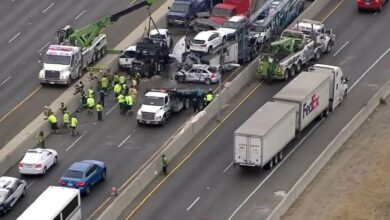
What began as an ordinary Friday morning in Richmond, British Columbia, quickly turned into a major transportation disruption after a commercial truck collided with the Cambie Road overpass on Knight Street.
At approximately 7:15 a.m., a truck hauling a dump trailer struck the overpass when the trailer remained in an elevated position and failed to clear the bridge. The force of the collision was severe enough to separate the truck’s cab from the trailer, sending the vehicle skidding across the roadway. Although no injuries were reported, the crash immediately raised concerns about the structural integrity of the overpass and prompted the closure of all southbound lanes.
Emergency crews, transportation officials, and engineers responded rapidly to the scene. Their primary objective was to determine whether the bridge had sustained any damage that could compromise public safety. While the overpass falls under provincial jurisdiction, Richmond municipal engineers assisted in the assessment process as crews worked throughout the morning to remove debris and stabilize the trailer, which remained wedged against the structure for several hours.
Authorities urged motorists to avoid the area and seek alternate routes as traffic congestion intensified across the region.
The investigation is being led by the Richmond Road Safety Unit in partnership with the Ministry of Transportation and Infrastructure. Structural specialists are conducting detailed inspections to identify any hidden damage, including cracks, displaced joints, or weakened support components that may not be immediately visible.
The incident is the latest in a series of truck-overpass collisions that have plagued British Columbia in recent years. Similar crashes have frequently been linked to raised truck beds, improperly secured loads, or miscalculations involving vehicle height. Last year alone, provincial highways recorded multiple overpass strikes, highlighting an ongoing safety concern throughout the Lower Mainland and Fraser Valley.
Transportation experts note that driver error is often only part of the problem. Aging infrastructure, inconsistent signage, and roadway modifications can also contribute to clearance-related incidents. In some locations, resurfacing projects have reduced vertical clearance, while warning signs may be insufficient or difficult for drivers to notice.
Industry organizations have repeatedly called for stronger preventative measures. The British Columbia Trucking Association has advocated for advanced over-height detection systems that use laser or infrared technology to alert drivers before they approach low-clearance structures. The association has also emphasized the importance of rigorous driver training, regular equipment inspections, and improved fleet monitoring systems capable of identifying potential risks before they lead to accidents.
According to engineers, even when an overpass appears intact after a collision, significant internal damage can still occur. Impacts may weaken structural components, loosen joints, or place stress on reinforcements hidden within the bridge. As a result, every strike requires a comprehensive engineering review before traffic can safely resume.
The closure of Knight Street created ripple effects throughout the region’s transportation network. As one of Metro Vancouver’s key commercial corridors, the route plays an important role in connecting Richmond with Vancouver, Delta, and the Fraser Valley. The disruption delayed deliveries, affected logistics operations, and forced thousands of commuters onto alternate roads, creating significant congestion throughout the day.
For businesses dependent on reliable transportation routes, even a single overpass collision can carry substantial economic consequences. Delayed shipments, increased fuel consumption, and disrupted supply chains often extend the impact far beyond the immediate crash site.
Safety experts argue that preventing future incidents will require a combination of technology, education, and infrastructure improvements. Recommended solutions include over-height detection systems, real-time GPS integration for commercial vehicles, enhanced driver training programs, and ongoing evaluations of bridge clearances across the province.
Many transportation analysts also believe that Canada’s aging infrastructure requires renewed investment as freight traffic continues to increase. Proposals under discussion include integrating bridge-clearance databases directly into commercial navigation systems and expanding the use of automated warning technologies along major trucking routes.
The Knight Street collision serves as a powerful reminder of how a single mistake can disrupt an entire region. While the immediate danger was contained and no lives were lost, the incident underscores the importance of proactive safety measures designed to prevent similar events before they occur.
Ultimately, ensuring the safety of critical transportation corridors requires cooperation among drivers, trucking companies, engineers, regulators, and government agencies. As officials continue their investigation, the lessons learned from this crash will likely contribute to broader conversations about infrastructure resilience, transportation safety, and the growing need for modern preventative technologies.
For many observers, the Richmond overpass collision is more than just a traffic incident—it is a warning that maintaining safe and reliable transportation networks demands constant vigilance, ongoing investment, and a shared commitment to preventing avoidable accidents before they happen.