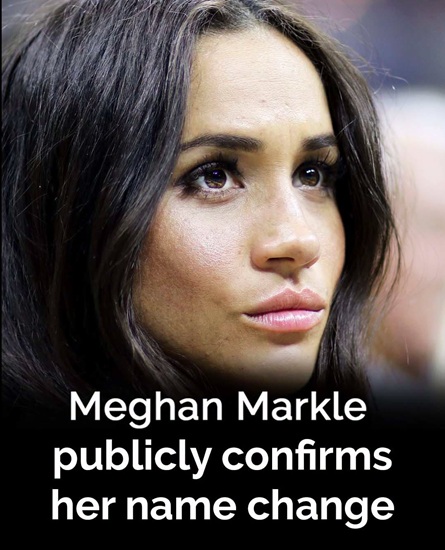
Recent comments by Meghan Markle have reignited public interest in one of the British royal family’s most complex topics: names, titles, and identity. The discussion began after Meghan referred to herself using the name “Sussex” in several public settings, prompting widespread debate about royal traditions and what the choice represents.
The conversation gained traction following Meghan’s appearance in the Netflix lifestyle series With Love, Meghan, where she spoke openly about family life, motherhood, and personal identity. During one segment, television personality Mindy Kaling referred to her as “Meghan Markle.” Meghan gently corrected her, explaining that she now considers “Sussex” to be her family name.
According to Meghan, sharing the same name as her husband and children carries special meaning. She described it as a reflection of their family bond and the life they have built together. For her, the name represents more than a title—it symbolizes a shared identity between herself, Prince Harry, Prince Archie, and Princess Lilibet.
The Duke and Duchess of Sussex titles were bestowed upon Meghan and Harry by Queen Elizabeth II when they married in 2018. Since then, “Sussex” has become closely associated with their family. Their children also carry titles connected to Sussex, making the name a familiar part of their public identity.
While some observers were surprised by Meghan’s comments, the discussion intensified after television host Drew Barrymore introduced her as “Meghan Sussex” during an appearance on The Drew Barrymore Show. The introduction quickly caught the attention of viewers and royal commentators, many of whom debated whether the use of “Sussex” as a surname reflected a new direction for the family or simply a personal preference.
For supporters, Meghan’s explanation was straightforward. They viewed the choice as a meaningful expression of family unity, arguing that many families naturally choose to identify under a shared name. From this perspective, using “Sussex” publicly serves as a symbol of connection rather than a formal rebranding.
Critics, however, questioned the practice. Some pointed out that “Sussex” is technically a territorial designation linked to a royal title rather than a traditional surname. They noted that members of the royal family generally use “Mountbatten-Windsor” as their official surname when one is required for legal or administrative purposes. As a result, questions arose about the distinction between formal names, royal titles, and personal identity.
Royal historians and commentators have also highlighted that the royal family has long used flexible naming conventions. Throughout history, royals have often adopted surnames based on their titles. Prince Harry himself used “Wales” during his military service because his father was then the Prince of Wales. Similar practices have been common among younger members of the royal family for generations.
Because of this tradition, some experts argue that Meghan’s use of “Sussex” is not particularly unusual. Instead, they see it as part of a long-standing royal custom in which titles frequently serve as practical identifiers in everyday situations.
Public reaction has remained divided. Supporters view the choice as a modern and relatable way of emphasizing family identity, while critics believe it blurs the distinction between titles and surnames. Social media discussions have reflected these contrasting views, with thousands weighing in on what might otherwise seem like a simple naming preference.
Adding another dimension to the story, Meghan’s father, Thomas Markle, publicly expressed sadness over the reduced use of the Markle family name. He has stated that the surname carries deep personal significance for him and his family, and his comments introduced a more emotional aspect to the debate.
Despite the controversy, royal experts note that there is no clear rule preventing the informal use of “Sussex” as a family identifier. While official documents may still rely on established legal naming conventions, everyday usage often allows for greater flexibility. This distinction helps explain why Meghan may be referred to by different names depending on the setting.
Ultimately, the discussion surrounding Meghan and the name “Sussex” goes beyond titles and royal protocol. It touches on broader themes of family, identity, tradition, and personal choice. In an era when public figures are constantly defining and redefining their personal brands, even something as simple as a name can become a topic of global conversation.
Whether people view the choice as symbolic, practical, or controversial, one thing is clear: the debate reflects the ongoing fascination with the modern royal family and the ways its members balance centuries-old traditions with contemporary life. As the conversation continues, both “Meghan Markle” and “Meghan Sussex” are likely to remain part of the public vocabulary for years to come.